

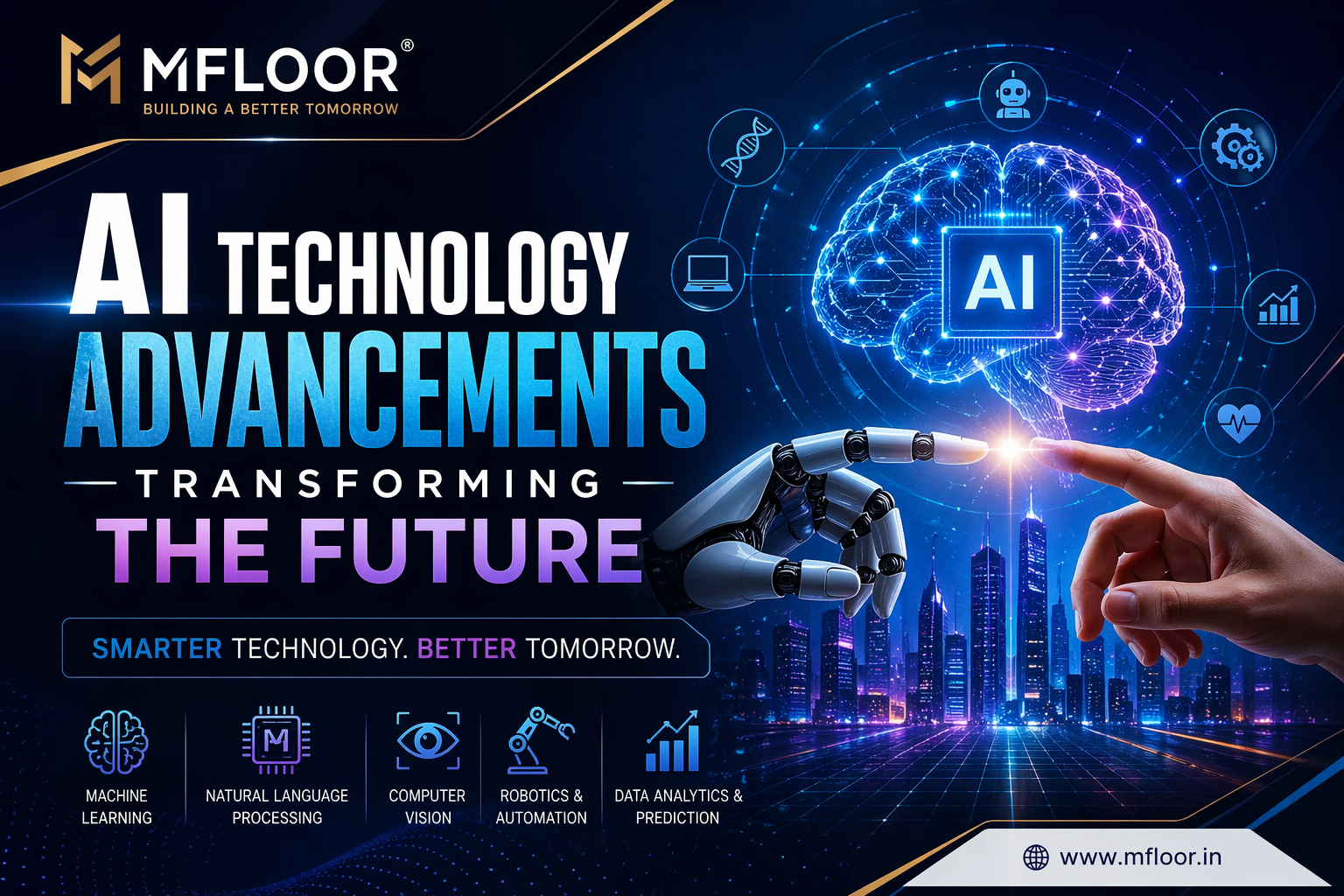
Artificial Intelligence (AI) has moved from a futuristic concept to a transformative force reshaping industries, economies, and daily life. Over the past decade—especially in the 2020s—advancement in AI technology have accelerated at an unprecedented pace, driven by improvements in computing power, data availability, and innovative algorithms. This article explores the most significant developments in AI and their real-world impact.
1. Rise of Generative AI
One of the most groundbreaking advancements is Generative AI—systems capable of creating text, images, music, videos, and even code.
Modern AI models can:
- Write human-like articles and blogs
- Generate realistic images and artwork
- Compose music and voiceovers
- Assist in coding and software development
These tools are revolutionizing industries like marketing, design, entertainment, and education by significantly reducing time and effort.
2. Natural Language Processing (NLP) Breakthroughs
AI systems have become remarkably better at understanding and generating human language.
Key improvements:
- Context-aware conversations
- Multilingual capabilities
- Real-time translation
- Sentiment analysis
Applications include:
- Chatbots and virtual assistants
- Customer support automation
- Content creation tools
- Legal and medical document analysis
NLP has made human-computer interaction more intuitive than ever before.
3. Computer Vision Advancements
Computer Vision allows machines to interpret and understand visual data from the world.
Key developments:
- Facial recognition systems
- Object detection and tracking
- Medical imaging analysis
- Autonomous vehicle vision systems
Industries benefiting include:
- Healthcare (early disease detection)
- Security and surveillance
- Retail (checkout-free stores)
- Automotive (self-driving technology)
4. AI in Healthcare
AI is transforming healthcare by improving diagnosis, treatment, and patient care.
Key innovations:
- Predictive analytics for disease detection
- AI-assisted surgeries
- Drug discovery acceleration
- Personalized treatment plans
AI systems can analyze massive medical datasets faster than humans, leading to earlier and more accurate diagnoses.
5. Autonomous Systems and Robotics
AI-powered robotics are becoming smarter and more independent.
Examples:
- Self-driving cars
- Delivery drones
- Industrial automation robots
- Smart home devices
These systems use a combination of AI technologies like machine learning, sensors, and real-time decision-making.
6. AI in Business and Finance
Businesses are leveraging AI for better decision-making and efficiency.
Key applications:
- Fraud detection in banking
- Algorithmic trading
- Customer behavior prediction
- Supply chain optimization
AI helps companies reduce costs, increase productivity, and gain competitive advantages.
7. Ethical AI and Responsible Development
With rapid growth, concerns about AI ethics have also increased.
Key issues:
- Data privacy
- Bias in AI models
- Job displacement
- Security risks
Organizations and governments are now focusing on Responsible AI, ensuring fairness, transparency, and accountability.
8. AI and Human Collaboration
Rather than replacing humans, modern AI is increasingly designed to augment human capabilities.
Examples:
- AI assisting doctors, not replacing them
- AI tools helping writers and designers
- Decision-support systems in business
This collaborative approach is creating new job roles and enhancing productivity.
9. Future of AI
The future of AI looks even more promising, with ongoing research in areas like:
- Artificial General Intelligence (AGI)
- Quantum computing integration
- Advanced robotics
- Brain-computer interfaces
AI is expected to become more adaptive, explainable, and deeply integrated into everyday life.
Conclusion
Advancements in AI technology are transforming nearly every aspect of society—from healthcare and education to business and entertainment. While the opportunities are vast, it is equally important to address ethical challenges and ensure responsible use.
AI is no longer just a tool—it is becoming a powerful partner in shaping the future.



AI’s potential to reshape industries like web design is really exciting. With increased automation and personalization, the user experience will be transformed in ways we can’t even imagine yet!
Really insightful breakdown — the practical applications section is especially well done.
The acceleration in AI capability over the past decade has been remarkable across nearly every dimension — from natural language understanding to computer vision to multimodal processing. One area where the practical impact is immediately visible is speech-to-text, where modern AI transcription tools have become accurate enough to replace manual note-taking across healthcare, legal, education, and media industries.
Great perspective on where AI tools are heading. From a creative production angle, GetImgAI has been part of our toolkit for a few months and the multi-model approach does make a tangible difference for varied project types.
This recipe breakdown is genuinely helpful — the focus on whole foods and timing really resonates. I’ve been working on nutrition content creation lately, and using Miso One’s AI voiceover has made turning text-heavy posts like this into accessible audio much easier.
The section on AI’s impact on manufacturing quality control is particularly relevant right now — computer vision inspection systems have matured to the point where deployment costs are within reach for mid-sized operations. Good overview of where the real enterprise adoption is happening.
A solid high-level survey — the through-line that compute, data, and algorithms all had to mature together is the part most casual coverage misses. Generative AI grabs the headlines, but the quieter infrastructure gains are what actually made this moment possible.
Excellent breakdown straightforward and super useful.
This guide is so complete and easy to understand. Great work!