
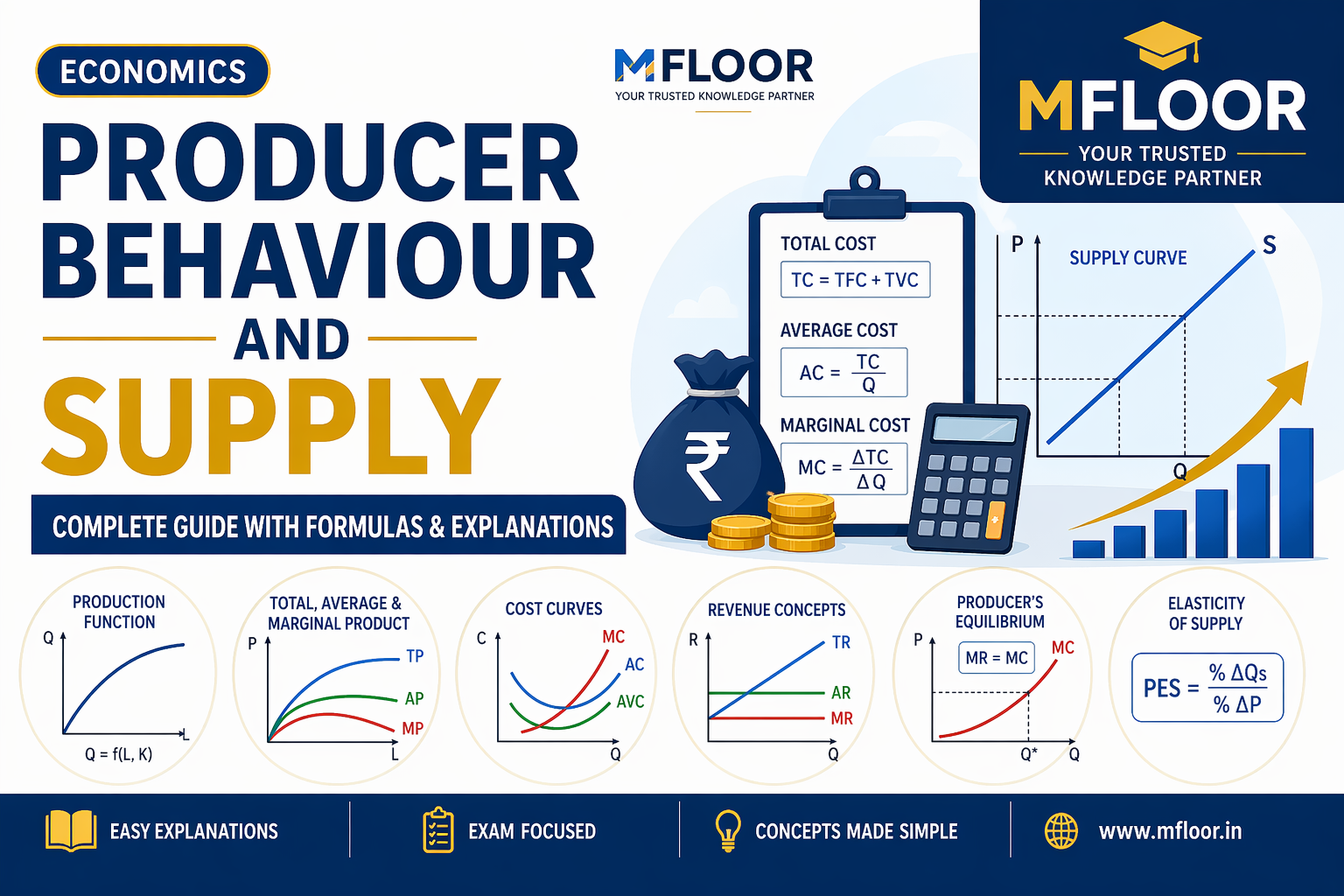
📘 Producer Behaviour and Supply – Complete Guide (WordPress Format)
🔹 1. Production Function
Meaning:
A production function shows the relationship between inputs (like labour and capital) and output produced.
Formula:
Q = f(L, K)
Where:
- Q = Output
- L = Labour
- K = Capital
🔸 Short Run vs Long Run
| Aspect | Short Run | Long Run |
|---|---|---|
| Factors | Some fixed, some variable | All factors variable |
| Flexibility | Limited | Full flexibility |
🔹 2. Total Product, Average Product & Marginal Product
- Total Product (TP): Total output produced
- Average Product (AP): Output per unit of labour
- Marginal Product (MP): Additional output from one more unit of labour
Formulas:
AP = TP / L
MP = ΔTP / ΔL
🔸 Relationship Between AP and MP
- When MP > AP → AP rises
- When MP < AP → AP falls
- When MP = AP → AP is maximum
🔹 3. Returns to a Factor (Law of Variable Proportions)
This law operates in the short run when one factor is variable.
Stages:
- Increasing Returns
- MP increases
- Better use of fixed factors
- Diminishing Returns
- MP decreases but remains positive
- Most practical stage
- Negative Returns
- MP becomes negative
- Overutilization
🔹 4. Cost Concepts (Short Run)
🔸 Total Costs
- Total Cost (TC): Total production cost
Formula:TC = TFC + TVC
- Total Fixed Cost (TFC): Cost that remains constant (e.g., rent)
- Total Variable Cost (TVC): Cost that changes with output
🔸 Average Costs
- Average Cost (AC):
AC = TC / Q
- Average Fixed Cost (AFC):
AFC = TFC / Q
- Average Variable Cost (AVC):
AVC = TVC / Q
🔸 Marginal Cost
MC = ΔTC / ΔQ
🔸 Cost Relationships
- MC cuts AC and AVC at their minimum points
- When MC < AC → AC falls
- When MC > AC → AC rises
- AFC continuously declines
🔹 5. Revenue Concepts
- Total Revenue (TR):
TR = P × Q
- Average Revenue (AR):
AR = TR / Q
- Marginal Revenue (MR):
MR = ΔTR / ΔQ
🔸 Revenue Relationships
- When MR > AR → AR rises
- When MR < AR → AR falls
- In perfect competition:
MR = AR = Price
🔹 6. Producer’s Equilibrium
Meaning:
A producer is in equilibrium when profit is maximized.
🔸 Conditions:
MR = MC
MC must be rising.
🔹 7. Supply
Meaning:
Supply refers to the quantity a producer is willing to sell at different prices.
🔸 Market Supply
Total supply of all firms in the market.
🔸 Determinants of Supply
- Price of the good
- Cost of production
- Technology
- Government policies (taxes/subsidies)
- Prices of related goods
- Future expectations
🔹 8. Supply Schedule & Supply Curve
- Supply Schedule: Table showing price vs quantity supplied
- Supply Curve: Graphical representation
👉 Slope: Upward (positive relationship)
🔹 9. Movement vs Shift in Supply Curve
🔸 Movement Along Curve
- Caused by change in price
- Expansion or contraction
🔸 Shift in Curve
- Caused by non-price factors
- Increase or decrease in supply
🔹 10. Price Elasticity of Supply (PES)
Meaning:
Measures responsiveness of supply to price change.
🔸 Formula:
PES = (% Change in Quantity Supplied) / (% Change in Price)
🔸 Types:
- Elastic:
PES > 1 - Inelastic:
PES < 1 - Unitary Elastic:
PES = 1
✅ Quick Revision Summary
TC = TFC + TVCMR = MC→ Equilibrium- Supply curve slopes upward
- MC cuts AC at minimum point
- MP determines AP behavior