
📊 Economics Meaning
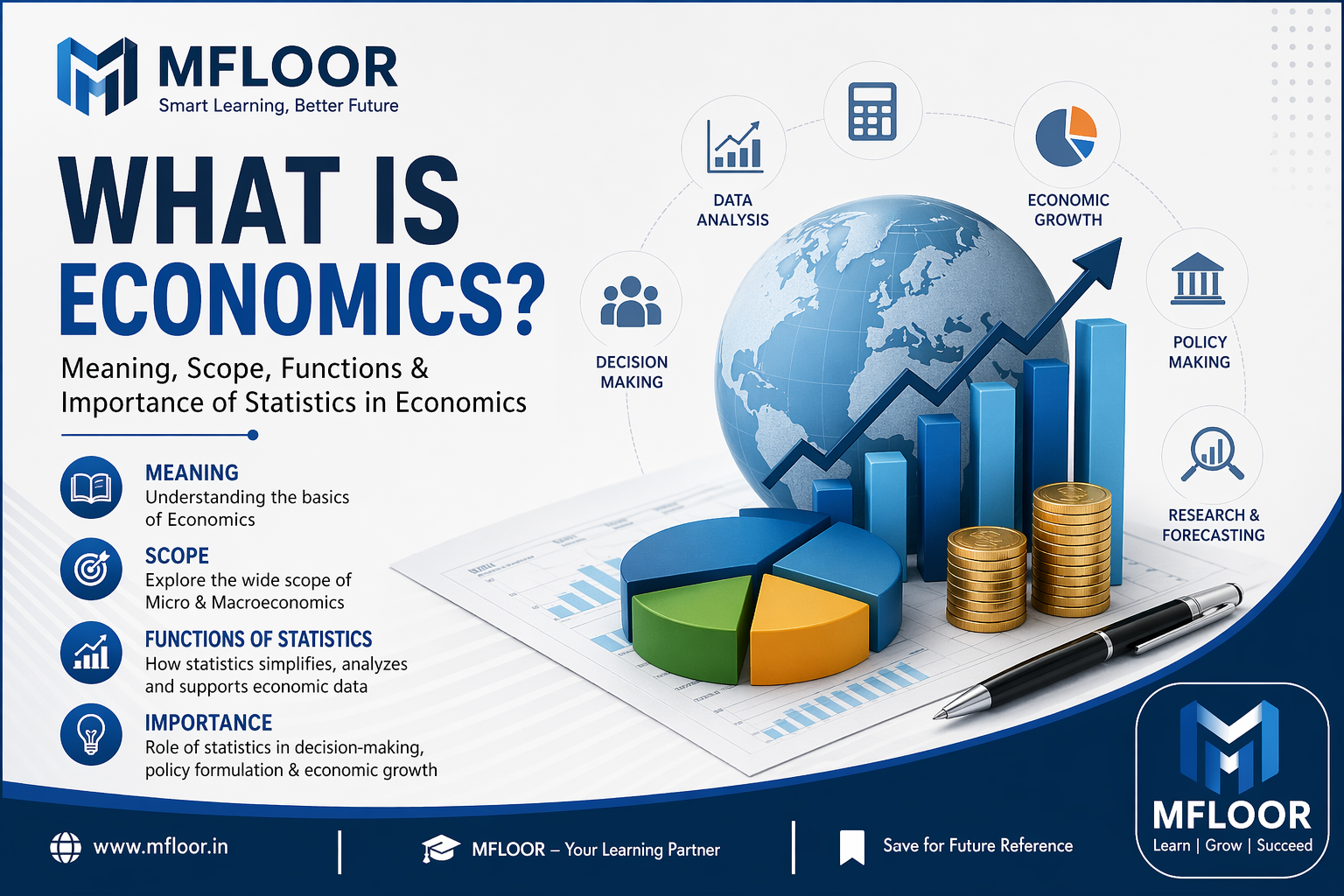
A Complete Guide to Meaning, Scope, Functions & Importance of Statistics in Economics
🌍 Introduction
Economics is a fundamental social science that shapes how individuals, businesses, and governments make decisions. From pricing of goods to national growth, economics influences every aspect of our daily life. Alongside economics, statistics plays a crucial role in analyzing data, forming policies, and predicting future trends.
This blog provides a detailed explanation of economics, along with the meaning, scope, functions, and importance of statistics in economics.
📖 Meaning of Economics
Economics is the study of how people use limited resources to satisfy unlimited wants. It focuses on decision-making regarding production, distribution, and consumption of goods and services.
📚 Definitions by Economists:
- Adam Smith: “Economics is the science of wealth.”
- Alfred Marshall: “Economics is the study of mankind in the ordinary business of life.”
- Lionel Robbins: “Economics is the science which studies human behavior as a relationship between ends and scarce means.”
👉 In simple terms, economics is about choice, scarcity, and resource allocation.
🔍 Scope of Economics
The scope of economics is broad and can be divided into two main branches:
1. Microeconomics 🧩
Deals with individual units such as consumers, firms, and industries.
- Price determination
- Consumer behavior
- Demand and supply
2. Macroeconomics 🌐
Focuses on the economy as a whole.
- National income
- Inflation
- Unemployment
- Economic growth
👉 Modern economics also includes:
- Development Economics
- Environmental Economics
- International Economics
📊 Meaning of Statistics in Economics
Statistics refers to the science of collecting, organizing, analyzing, and interpreting numerical data.
In economics, statistics helps in:
- Understanding economic problems
- Making informed decisions
- Forecasting future trends
⚙️ Functions of Statistics in Economics
1. Simplification of Data 📉
Large and complex economic data is simplified using averages, percentages, and charts.
2. Presentation of Facts 📊
Data is presented in tables, graphs, and diagrams for easy understanding.
3. Comparison 🔍
Statistics helps compare:
- Prices over time
- Income levels
- Economic growth of countries
4. Policy Formulation 🏛️
Governments use statistical data to design economic policies.
5. Forecasting 🔮
Statistical tools help predict future economic trends such as inflation and demand.
6. Testing Economic Theories 🧠
Economic theories are validated using statistical methods.
🌟 Importance of Statistics in Economics
1. Helps in Decision Making
Businesses and governments rely on data for planning and decision-making.
2. Economic Planning 📅
Statistical data is essential for national planning and budgeting.
3. Understanding Economic Problems
Issues like poverty, unemployment, and inflation are studied using statistics.
4. Measurement of Economic Variables
- National Income
- Per Capita Income
- Growth Rate
5. Supports Research 📚
Researchers use statistical tools for economic analysis and studies.
6. Improves Accuracy
Decisions based on data are more reliable than assumptions.
📌 Relationship Between Economics and Statistics
Economics and statistics are closely related:
- Economics provides theories
- Statistics provides tools to test those theories
👉 Without statistics, economics would be theoretical, and without economics, statistics would be meaningless data.
🧾 Conclusion
Economics is a vital discipline that studies how resources are allocated to satisfy human wants. The scope of economics ranges from individual behavior to global economic systems.
Statistics acts as a backbone of economics by providing tools to analyze data, test theories, and make informed decisions. Together, they help governments, businesses, and individuals achieve efficient outcomes and sustainable growth.