
Explained the Concepts of Money and Banking.
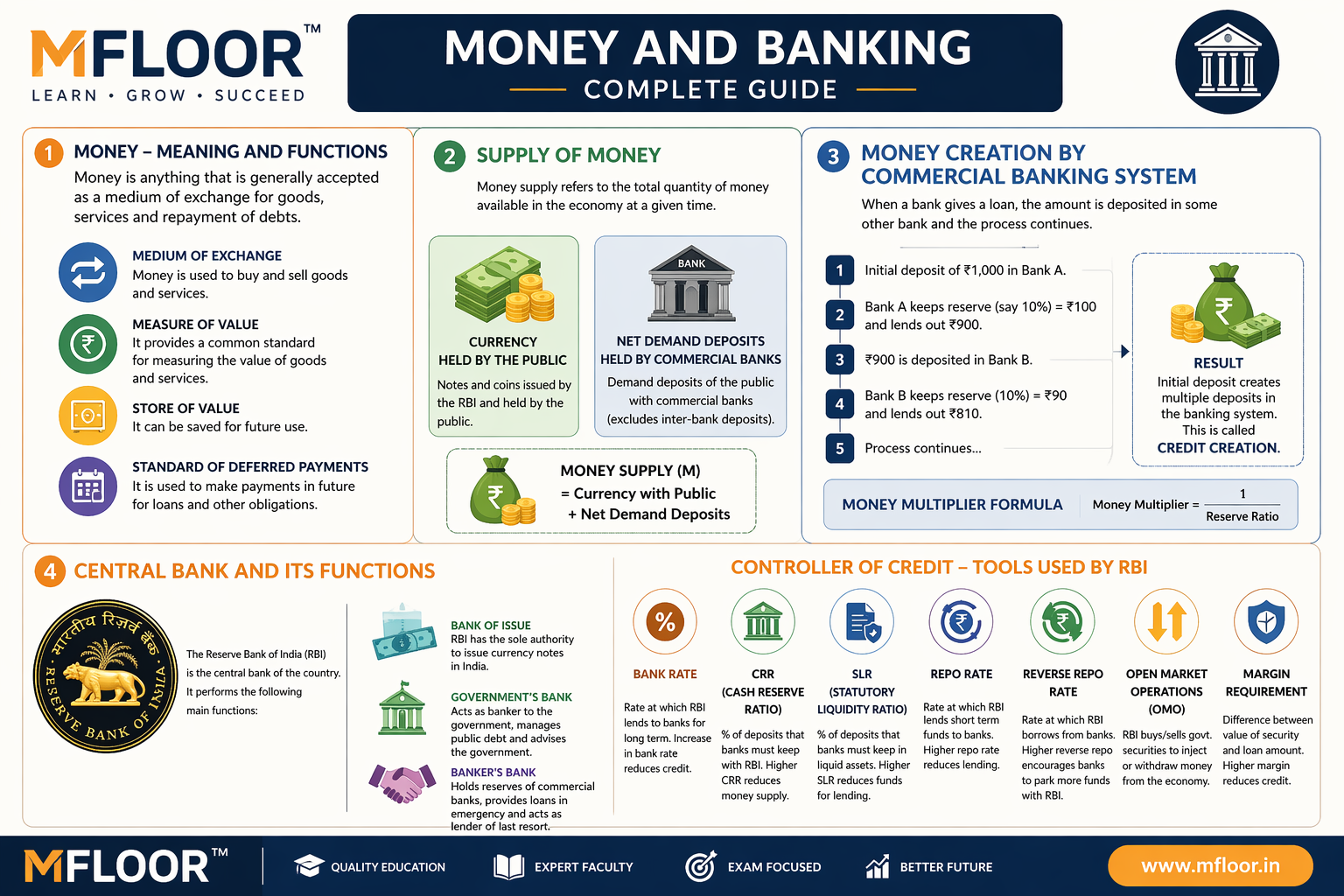
💰 1. Money – Meaning and Functions
🔹 Meaning of Money
Money is anything that is generally accepted as a medium of exchange for goods and services and for settling debts.
Examples: currency notes, coins, bank deposits.
🔹 Functions of Money
1. Medium of Exchange
Money eliminates the problem of barter system (double coincidence of wants).
Example: You don’t need to find someone who wants what you have.
2. Measure of Value (Unit of Account)
Money helps in expressing the value of goods and services in terms of a common unit (like Rupees ₹).
3. Store of Value
Money can be saved for future use.
Example: You can keep ₹100 today and use it later.
4. Standard of Deferred Payments
Money is used to settle future payments like loans and EMIs.
💵 2. Supply of Money
Money supply refers to the total amount of money available in the economy at a given time.
🔹 Components of Money Supply
1. Currency Held by the Public
- Notes and coins with people.
- Issued by the central bank (like Reserve Bank of India).
2. Net Demand Deposits Held by Commercial Banks
- Deposits that can be withdrawn anytime (like savings/current accounts).
- Includes:
- Demand deposits of public
- Excludes inter-bank deposits
🔹 Formula:
Money Supply (M) = Currency with Public + Demand Deposits
🏦 3. Money Creation by Commercial Banking System
Commercial banks create money through lending.
🔹 How It Works:
- A person deposits ₹1000 in a bank.
- Bank keeps a portion (say 10%) as reserve.
- Remaining ₹900 is given as a loan.
- That ₹900 is deposited again in another bank.
- Process continues…
🔹 Result:
- Initial ₹1000 creates multiple deposits
- This is called Credit Creation
🔹 Money Multiplier Concept
Money created depends on reserve ratio.
Money Multiplier=1Reserve Ratio\text{Money Multiplier} = \frac{1}{\text{Reserve Ratio}}
Example: If reserve ratio = 10% → Multiplier = 10
🏛️ 4. Central Bank and Its Functions
The central bank of India is the Reserve Bank of India (RBI).
🔹 (A) Bank of Issue
- RBI has the sole authority to issue currency notes.
- Ensures uniformity and trust in money.
🔹 (B) Government’s Bank
- RBI acts as a banker to the government.
- Functions:
- Receives and makes payments
- Manages public debt
- Advises government
🔹 (C) Banker’s Bank
- Commercial banks keep reserves with RBI.
- RBI provides loans during emergencies.
- Acts as lender of last resort.
🔹 (D) Controller of Credit
RBI controls money supply using monetary policy tools:
1. Bank Rate
- Rate at which RBI lends to commercial banks (long-term).
- ↑ Bank Rate → Loans become costly → Less borrowing → Less money supply
2. Cash Reserve Ratio (CRR)
- Percentage of deposits banks must keep with RBI.
Example: CRR = 4% → Banks keep ₹4 out of ₹100 with RBI.
- ↑ CRR → Less money for lending → Reduces money supply
3. Statutory Liquidity Ratio (SLR)
- Portion of deposits banks must keep in liquid assets (cash, gold, govt. securities).
- ↑ SLR → Less funds for loans → Less money supply
4. Repo Rate
- Rate at which RBI lends short-term money to banks.
- ↑ Repo Rate → Borrowing costly → Loans decrease → Money supply falls
5. Reverse Repo Rate
- Rate at which RBI borrows from banks.
- ↑ Reverse Repo → Banks deposit more with RBI → Less money in economy
6. Open Market Operations (OMO)
- RBI buys/sells government securities.
- Buy securities → Inject money into economy
- Sell securities → Withdraw money from economy
7. Margin Requirement
- Difference between loan amount and value of security pledged.
Example:
- Security value = ₹100
- Loan given = ₹80
- Margin = ₹20
- ↑ Margin → Less borrowing → Less credit creation
📌 Summary (Quick Revision)
- Money: Medium of exchange, store of value, unit of account.
- Money Supply = Currency + Demand Deposits
- Commercial Banks: Create money via lending (credit creation).
- RBI Functions:
- Issue currency
- Banker to govt & banks
- Controls credit via CRR, SLR, Repo, etc.