
🚀 Europa Clipper: A Deep Dive into NASA’s Mission to an Ocean World
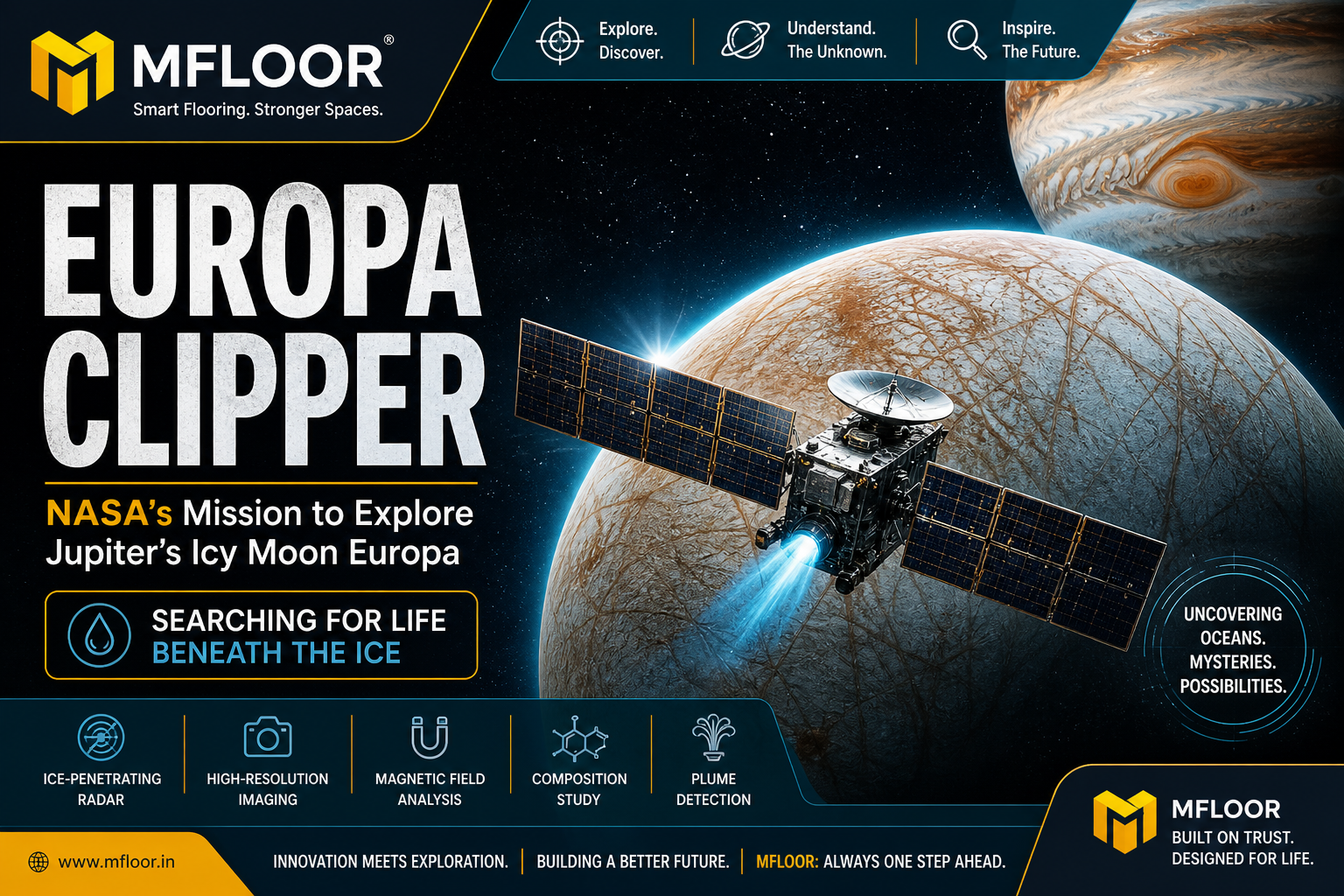
The Europa Clipper mission is one of the most ambitious planetary exploration projects ever undertaken by NASA. It is specifically designed to investigate whether the icy moon Europa could support life. But to truly understand its importance, we need to go deeper—into its science, engineering, and long-term implications.
🌌 1. The Scientific Background: Why Europa Matters So Much
Europa is one of the four large moons discovered by Galileo Galilei in 1610. What makes it extraordinary is not its size, but what lies beneath its surface.
🧊 The Ice Shell
Europa’s outer layer is a thick sheet of water ice. Estimates suggest:
- Thickness: 10–30 km
- Constantly reshaped by cracks, ridges, and shifting plates
These features indicate geological activity, which is unusual for a moon.
🌊 The Hidden Ocean
Beneath this ice lies a global subsurface ocean:
- Depth: ~60–150 km
- Contains more water than all of Earth’s oceans combined
This ocean is kept liquid due to tidal heating caused by Jupiter’s gravity.
👉 This links directly to the scientific concept of Tidal heating, where gravitational forces generate internal heat.
🔥 2. Conditions for Life on Europa
For life as we know it, three key ingredients are required:
1. 💧 Liquid Water
Europa already checks this box.
2. ⚡ Energy Source
- Tidal heating may power hydrothermal vents (similar to Earth’s deep oceans)
3. 🧪 Chemical Building Blocks
- Organic molecules may exist on the surface or ocean
👉 These conditions mirror ecosystems near Earth’s deep-sea vents, where life thrives without sunlight.
🛰️ 3. Why “Clipper”? Mission Design Explained
The name “Clipper” refers to fast sailing ships—symbolizing multiple quick passes.
Instead of orbiting Europa directly, the spacecraft will:
- Orbit Jupiter
- Perform ~50 close flybys of Europa
🤔 Why Not Orbit Europa Directly?
Because:
- Jupiter emits intense radiation
- Staying in Europa’s orbit would damage instruments quickly
So, flybys reduce exposure while maximizing data collection.
⚙️ 4. Spacecraft Design & Engineering Marvels
Europa Clipper is massive and highly advanced:
- 📏 Span: ~30 meters (solar panels extended)
- ⚖️ Weight: ~6,000 kg
- 🔋 Power: Solar energy (even at Jupiter’s distance!)
☢️ Radiation Protection
Jupiter’s radiation belts are deadly for electronics. Engineers use:
- Thick aluminum vault shielding
- Radiation-hardened components
🔬 5. Scientific Payload: Instruments in Detail
Europa Clipper carries 9 major instruments, each with a specific purpose:
📡 1. Radar for Europa Assessment (REASON)
- Penetrates ice shell
- Maps subsurface structures
📷 2. Europa Imaging System (EIS)
- Captures ultra-high-resolution images
- Maps surface geology
🌡️ 3. Europa Thermal Emission Imaging System (E-THEMIS)
- Detects heat anomalies
- Identifies possible active regions
🧲 4. Magnetometer (ECM)
- Measures magnetic field changes
- Confirms ocean conductivity
🧪 5. Mass Spectrometer (MASPEX)
- Analyzes gases and particles
- Detects organic molecules
💨 6. Surface Dust Analyzer (SUDA)
- Studies ejected particles
- Searches for biosignatures
👉 If plumes exist, the spacecraft could literally “taste” Europa’s ocean.
🚀 6. Launch, Trajectory & Journey
Europa Clipper’s journey is complex:
🛰️ Launch Vehicle
- Likely aboard Falcon Heavy
🌍 Gravity Assists
- Uses Earth and possibly Mars to gain speed
⏳ Travel Time
- ~5–6 years to reach Jupiter
🪐 Arrival
- Enters orbit around Jupiter
- Begins flyby sequence
🌋 7. The Mystery of Water Plumes
One of the most exciting possibilities is cryovolcanism:
- Europa may eject water vapor through cracks
- Similar to geysers
This connects to the concept of Cryovolcanism.
👉 If confirmed, this allows direct sampling of the ocean without drilling through ice.
🧠 8. Data Collection Strategy
Each flyby will:
- Focus on a different region
- Collect layered data (surface, subsurface, atmosphere)
Over time, scientists will:
- Build a 3D model of Europa
- Identify “hotspots” for future landing missions
⚠️ 9. Challenges and Risks
☢️ Radiation
- Jupiter’s radiation is 1,000x stronger than Earth’s
❄️ Extreme Temperatures
- Surface: ~ -160°C
📡 Communication Delay
- Signals take ~30–50 minutes round trip
🌍 10. How Europa Clipper Could Change Everything
This mission could:
🌱 Redefine Life in the Universe
If organic chemistry or biosignatures are found:
- Life may not be rare
- Ocean worlds could be common habitats
🧭 Guide Future Missions
- Landing sites selection
- Potential drilling missions
🌌 Expand Astrobiology
It directly contributes to the field of Astrobiology.
🔮 11. What Comes After Europa Clipper?
Possible next steps:
- 🤖 Europa Lander Mission
- 🧊 Ice-penetrating probes
- 🌊 Ocean exploration robots (long-term future)
Other targets:
- Saturn’s moon Enceladus
- Titan (methane lakes)
📝 Final Thoughts
Europa Clipper is more than a mission—it’s a scientific turning point.
It bridges:
- Planetary science
- Oceanography
- Biology
And it tackles one of humanity’s oldest questions:
👉 Is life unique to Earth, or is it hidden beneath icy worlds like Europa?