
📉 Understanding Elasticity of Demand: A Key to Smart Economic Decisions
Introduction
Have you ever wondered why the price of some goods can rise sharply without affecting demand much, while even a small price hike causes demand for others to plummet? This behavior of consumers in response to price changes is captured by an important economic concept: Elasticity of Demand.
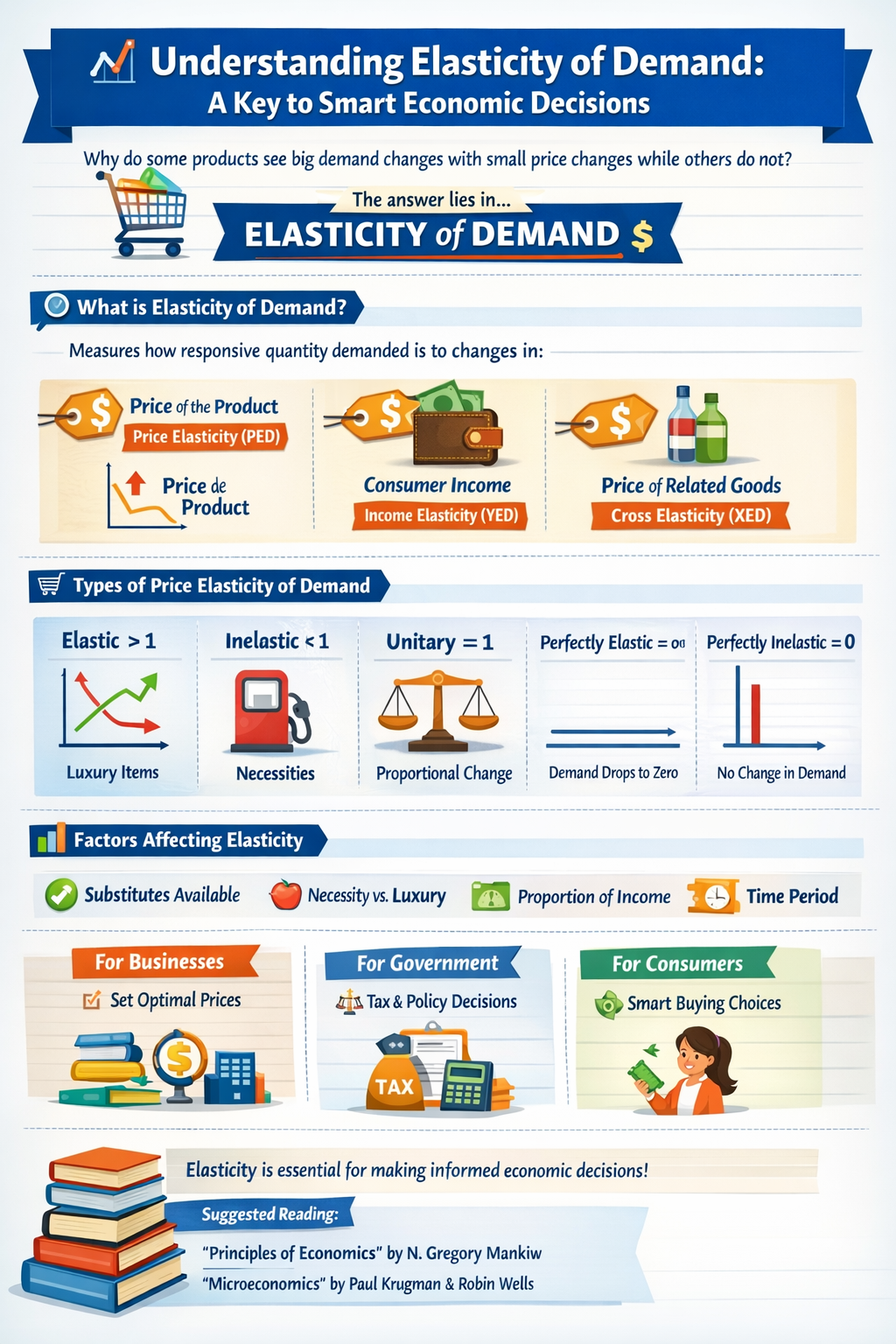
Elasticity of demand measures how much the quantity demanded of a good changes when there is a change in its price, income, or the price of related goods. It is a fundamental tool in economics that helps businesses, policymakers, and consumers make informed decisions.
🔍 What Is Elasticity of Demand?
Elasticity of demand refers to the responsiveness of quantity demanded to changes in various economic factors, most commonly:
Price of the product (Price Elasticity of Demand)
Income of consumers (Income Elasticity of Demand)
Price of related goods (Cross Elasticity of Demand)
Let’s break these down.
1️⃣ Price Elasticity of Demand (PED)
Definition: It measures the responsiveness of quantity demanded to a change in the price of the good.
Formula:
PED= % Change in Quantity Demanded (Divided by) % Change in Price
Types of PED:
Elastic (>1): A small change in price leads to a large change in quantity demanded. Example: luxury items, electronics.
Inelastic (<1): Quantity demanded changes little even with a significant change in price. Example: petrol, medicines.
Unitary (=1): Percentage change in demand equals percentage change in price.
Perfectly Elastic (=∞): Consumers buy none if the price rises at all.
Perfectly Inelastic (=0): Quantity demanded doesn’t change regardless of price.
2️⃣ Income Elasticity of Demand (YED)
Definition: It measures the responsiveness of quantity demanded to changes in consumer income.
Types of Goods:
Normal Goods: Demand rises with income (YED > 0)
Inferior Goods: Demand falls as income rises (YED < 0)
Luxury Goods: Demand rises more than proportionally as income rises (YED > 1)
Example: As income increases, people may buy more organic food (normal good) and fewer instant noodles (inferior good).
3️⃣ Cross Elasticity of Demand (XED)
Definition: It measures the responsiveness of demand for one good to the price change of another good.
Types:
Substitutes (XED > 0): Price of Pepsi rises → demand for Coke increases.
Complements (XED < 0): Price of printers rises → demand for ink cartridges falls.
📈 Factors Affecting Elasticity of Demand
Several factors determine how elastic or inelastic a product’s demand is:
Availability of Substitutes
More substitutes = more elastic demand.Necessity vs Luxury
Necessities = inelastic; Luxuries = elastic.Proportion of Income Spent
Expensive items = elastic; low-cost items = inelastic.Time Period
Longer time = more elastic (people find alternatives over time).Addictiveness or Habit
Goods like tobacco tend to be inelastic due to habitual use.
📊 Real-Life Applications of Elasticity
For Businesses:
Helps in pricing strategy: Raising prices on inelastic goods increases revenue.
Guides product development and marketing decisions.
For Government:
Helps design tax policies (e.g., higher taxes on inelastic goods like cigarettes).
Assists in evaluating the effects of price controls and subsidies.
For Consumers:
Understanding elasticity helps predict price impacts and make better purchasing decisions.
🧠 Summary: Why Elasticity Matters
Elasticity of demand isn’t just a textbook concept — it’s a real-world tool that influences everything from corporate pricing to government taxation. Whether you’re a business owner trying to set the right price or a student learning the ropes of economics, understanding elasticity helps you see how demand reacts to change — and why.
✅ Key Takeaways:
Elasticity of demand shows how quantity demanded changes with price, income, or related goods.
Price elasticity helps businesses set optimal pricing.
Income and cross elasticity explain consumer behavior during economic shifts.
Elasticity is crucial for economic forecasting, policy making, and business strategy.
📘 Suggested Reading:
“Principles of Economics” by N. Gregory Mankiw
“Microeconomics” by Paul Krugman & Robin Wells