
1. Distribution of Legislative Powers (Union & State)
In the Constitution of India, law-making powers are divided between the Central Government (Union) and State Governments.
There are 3 lists:
🔹 Union List
- Only Parliament can make laws
- Examples: Defence, Foreign Affairs, Currency
🔹 State List
- Only State Legislatures can make laws
- Examples: Police, Public Health, Agriculture
🔹 Concurrent List
- Both Parliament and States can make laws
- Examples: Education, Forest, Marriage
- If there is a conflict → Central law wins
2. Territorial Distribution of Powers
This means where a law applies geographically.
- Parliament can make laws for whole India or any part
- State laws apply only within that state
- But Parliament can also make laws for Indian citizens outside India
👉 Example: A law made by Parliament can apply to Indians living abroad.
3. Topical Distribution of Powers
“Topical” means subject-based division.
- Subjects are divided into the three lists
- Each level of government can only make laws on its assigned topics
👉 Example:
- Defence → Union List → Only Parliament
- Police → State List → Only States
4. Power of Parliament to Legislate on State Matters
Normally, Parliament cannot make laws on State List subjects, but there are exceptions:
🔸 When can Parliament make laws on State subjects?
- National Interest (Rajya Sabha approval)
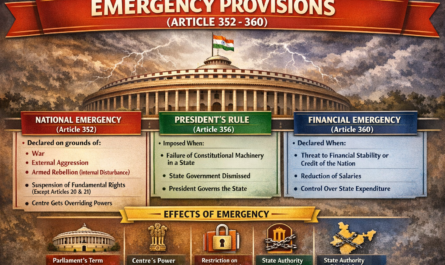
- During Emergency
- When States request (2 or more states)
- To implement international agreements
- During President’s Rule in a state
👉 So, Parliament can override states in special situations.
5. Doctrine of Territorial Nexus
This doctrine means:
👉 A state law can apply outside its territory if there is a real connection (nexus).
✔ Conditions:
- There must be a connection between the state and the subject
- The connection must be real, not artificial
👉 Example:
If a company operates in Bihar but is located outside, Bihar can tax it if it has a strong connection.
6. Doctrine of Pith and Substance
“Pith and Substance” means true nature or real purpose of a law.
👉 If a law slightly touches another list, it is still valid if its main subject is correct.
✔ Key Idea:
- Look at the main objective, not small overlaps
👉 Example:
A state law mainly about “agriculture” (State List) may affect trade (Union List), but it is still valid.
7. Doctrine of Colorable Legislation
“Colorable” means something disguised.
👉 This doctrine says:
- Government cannot do indirectly what it cannot do directly
✔ Key Idea:
- If a law looks legal but actually hides something illegal, it is invalid
👉 Example:
A state cannot make a law on a Union subject by giving it a different name.
🔚 Conclusion (Simple Summary)
- Powers are divided by subject (lists) and area (territory)
- Parliament is stronger but has limits
- Courts use doctrines like:
- Territorial Nexus → connection matters
- Pith & Substance → real purpose matters
- Colorable Legislation → hidden intention matters