

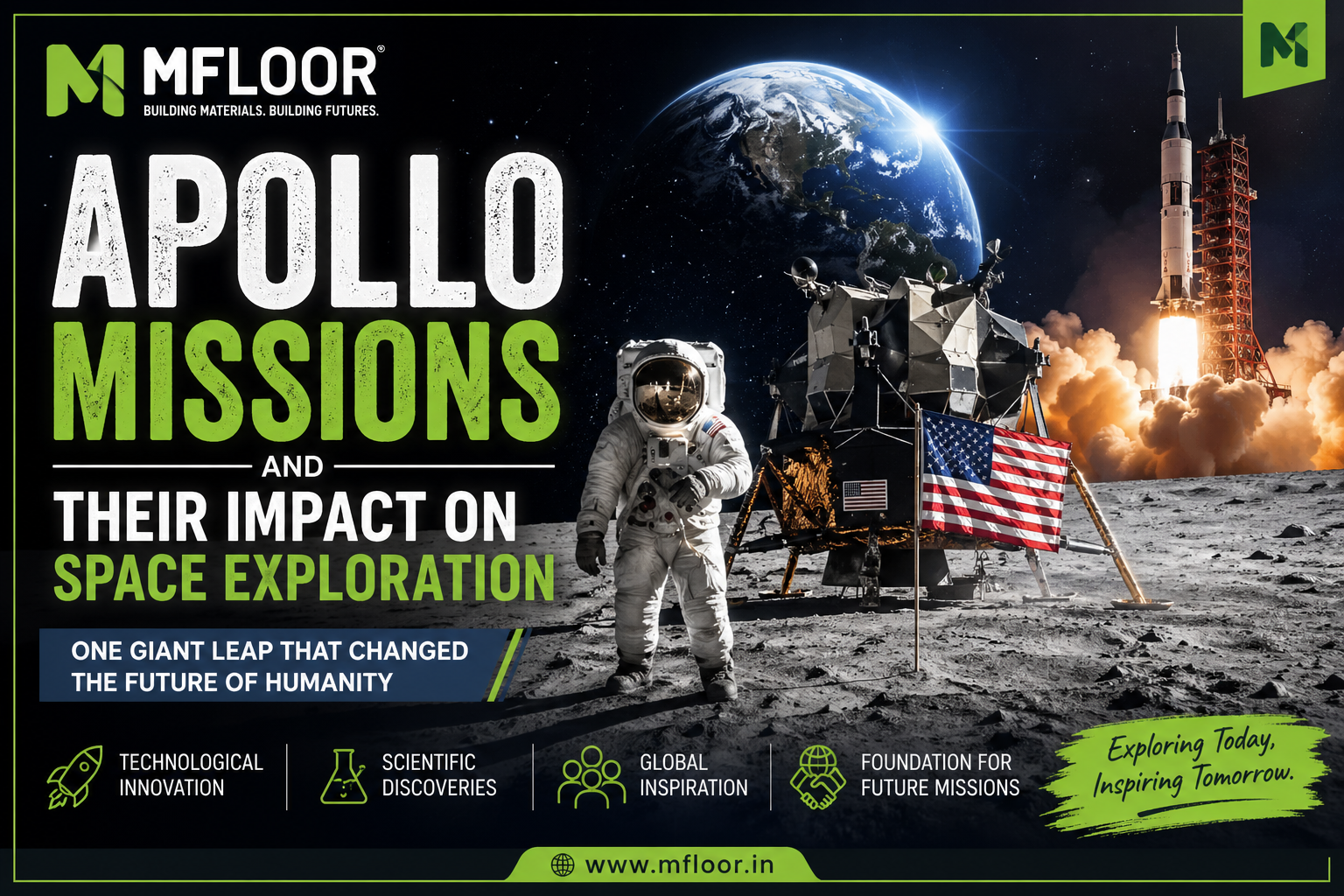
🚀 Apollo Missions and Their Impact on Space Exploration
🌕 Introduction
The Apollo missions stand as one of humanity’s greatest achievements, marking the first time humans left Earth’s orbit and walked on another celestial body. Conducted by NASA between 1961 and 1972, the Apollo program not only fulfilled a bold political goal but also revolutionized science, technology, and our understanding of the universe. From the historic landing of Neil Armstrong on the Moon to the scientific discoveries that followed, Apollo reshaped the future of space exploration.
🛰️ Background: The Space Race
The Apollo missions were born during the intense rivalry between the United States and the Soviet Union known as the Space Race. After early Soviet successes, the U.S. committed to landing a man on the Moon. In 1961, President John F. Kennedy famously declared the goal of achieving a lunar landing before the end of the decade.
🚀 Overview of the Apollo Missions
🔥 Apollo 1 (1967)
A tragic cabin fire during a ground test killed three astronauts. This disaster led to major safety improvements in spacecraft design and procedures.
🧪 Apollo 7–10 (1968–1969)
These missions tested critical systems:
- Apollo 7: First successful crewed flight
- Apollo 8: First orbit of the Moon
- Apollo 9 & 10: Tested lunar module and docking procedures
🌕 Apollo 11 (1969)
The most famous mission, Apollo 11, achieved the first human Moon landing. Neil Armstrong and Buzz Aldrin walked on the lunar surface, while Michael Collins remained in orbit. Armstrong’s words became legendary:
“That’s one small step for man, one giant leap for mankind.”
🔬 Apollo 12–17 (1969–1972)
These missions expanded lunar exploration:
- Conducted scientific experiments
- Collected lunar samples
- Used the Lunar Roving Vehicle (Apollo 15–17)
⚠️ Apollo 13 (1970)
An onboard explosion forced the mission to abort, but it became a symbol of human ingenuity and survival under pressure.
🌍 Major Impacts of the Apollo Missions
1. ⚙️ Technological Advancements
The Apollo program accelerated innovation across multiple industries:
- Computing: Development of the Apollo Guidance Computer, a precursor to modern computing
- Materials science: Heat-resistant materials and lightweight alloys
- Telecommunications: Advances in satellite communication
- Electronics: Miniaturization of circuits and components
👉 Many everyday technologies—smartphones, medical imaging, and GPS—trace their roots back to Apollo-era innovations.
2. 🔬 Scientific Discoveries
Apollo missions brought back 382 kg of lunar rocks and soil, leading to groundbreaking discoveries:
- The Moon is about 4.5 billion years old
- Evidence supporting the Giant Impact Hypothesis
- Insights into planetary geology and Earth’s early history
These findings transformed our understanding of how celestial bodies form and evolve.
3. 👨🚀 Advancement of Human Spaceflight
Apollo proved that:
- Humans can travel beyond Earth orbit
- Complex operations like docking and lunar landing are feasible
- Long-duration missions can be managed safely
👉 This directly led to:
- Space stations like the International Space Station
- Reusable spacecraft programs
- Future deep-space missions
4. 🌐 Political and Cultural Influence
The Apollo missions were a defining moment in global history:
- Demonstrated U.S. leadership during the Cold War
- Boosted national pride and global prestige
- Inspired millions to pursue careers in science and engineering
The Moon landing became a shared human achievement, watched by millions worldwide.
5. 🤝 Foundation for International Cooperation
Although Apollo was a competitive effort, it paved the way for collaboration:
- Apollo–Soyuz Test Project marked the first joint space mission
- Encouraged multinational cooperation in later programs like the ISS
Today, space exploration is largely collaborative rather than competitive.
6. 🌌 Shift in Space Exploration Strategy
After Apollo:
- Focus shifted from short-term achievements to long-term sustainability
- Increased emphasis on robotic missions (Mars rovers, probes)
- Development of reusable spacecraft
Programs like Artemis program aim to return humans to the Moon and eventually send missions to Mars.
🌠 Legacy of the Apollo Missions
The legacy of Apollo continues to shape modern exploration:
- Private companies like SpaceX and Blue Origin build on its foundation
- Renewed interest in lunar exploration
- The Moon as a stepping stone for Mars missions
Apollo proved that humanity can achieve extraordinary goals through determination, innovation, and collaboration.
🧠 Conclusion
The Apollo missions were more than just a journey to the Moon—they were a turning point in human history. They pushed the boundaries of technology, expanded scientific knowledge, and demonstrated the power of human ambition. Even decades later, their influence remains deeply embedded in modern space exploration, inspiring new generations to look beyond Earth and explore the cosmos.


The Apollo missions are a reminder of what humanity can achieve with collaboration and innovation. It’s incredible how much we learned from those early moon landings and how they continue to inspire exploration today.
The juxtaposition of the Apollo missions’ historical significance with the modern real estate listings is quite a unique angle for a blog post. It seems like a fascinating way to highlight how we’ve evolved from conquering space to defining our daily lives through premium property developments. This mix of deep space exploration and local housing projects in Jharkhand and West Bengal offers a fresh perspective on human progress.
Apollo Missions remain a fascinating benchmark for human ingenuity, even when viewed alongside the ambitious real estate milestones listed here. It is inspiring to see how the drive to explore the unknown parallels the efforts to build sustainable, modern living spaces in regions like Jharkhand and West Bengal.