
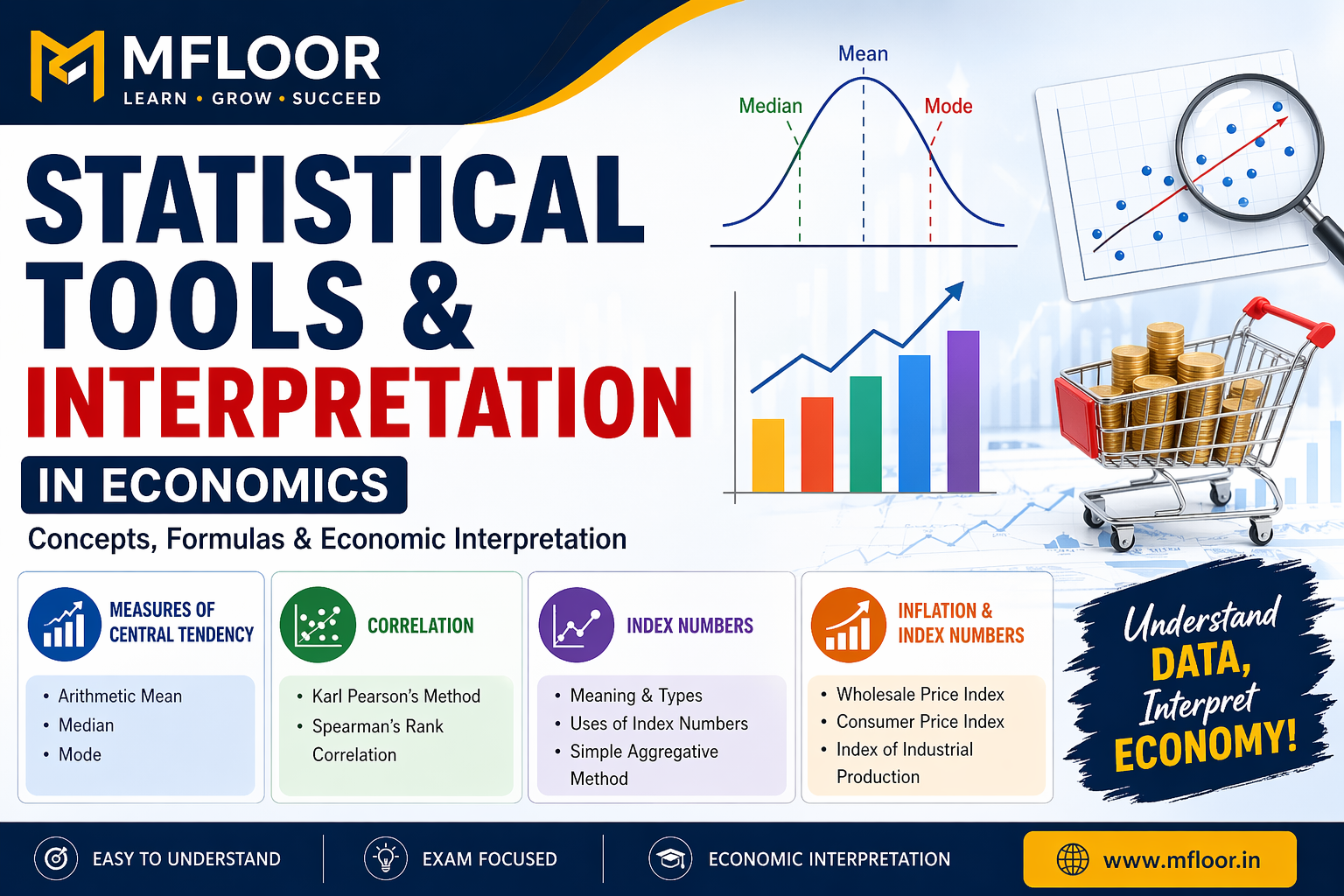
📊 Statistical Tools & Interpretation In Economics (Complete Guide for Students)
Statistical tools play a vital role in understanding economic data. In economics, it is not enough to just calculate results — we must also interpret them meaningfully.
🔍 What is Statistical Interpretation?
Statistical interpretation means:
- Solving numerical problems
- Explaining the economic meaning of results
👉 Example:
If the average income is ₹25,000 → it indicates the general standard of living of people in that group.
📌 Measures of Central Tendency
These measures help to find the central or representative value of a dataset.
🔹 1. Arithmetic Mean (Average)
Simple Format:
Where:
- = observations
- = number of observations
✅ Economic Interpretation:
- Shows the overall average level
- Used in income, production, and cost analysis
- Helps in policy decision-making
🔹 2. Median
- The middle value in an arranged dataset
✅ Economic Interpretation:
- Best for unequal income distribution
- Not affected by extreme values (rich/poor gap)
- Represents the true typical value
🔹 3. Mode
- The value that occurs most frequently
✅ Economic Interpretation:
- Shows most common consumer behaviour
- Useful in demand analysis and market trends
📌 Correlation
🔹 Meaning:
Correlation measures the relationship between two variables
👉 Examples:
- Income and consumption
- Price and demand
🔹 Properties of Correlation:
- Value ranges from -1 to +1
- +1 → Perfect positive correlation
- -1 → Perfect negative correlation
- 0 → No relationship
🔹 Scatter Diagram
A graphical method to show correlation.
✅ Interpretation:
- Upward slope → Positive correlation
- Downward slope → Negative correlation
🔹 Karl Pearson’s Coefficient of Correlation
Simple Format:
✅ Economic Interpretation:
- Measures strength and direction of relationship
- Widely used in economic research and analysis
🔹 Spearman’s Rank Correlation
(i) Without Repeated Ranks
Simple Format:
(ii) With Repeated Ranks
- Adjustments are made for tied ranks
✅ Economic Interpretation:
- Used when data is in ranking form
- Example: Preferences, performance rankings
📌 Index Numbers
🔹 Meaning:
Index numbers measure changes in economic variables over time
👉 Example:
- Price changes
- Cost of living
🔹 Types of Index Numbers
1. Wholesale Price Index (WPI)
- Measures prices at wholesale level
2. Consumer Price Index (CPI)
- Measures cost of living
3. Index of Industrial Production (IIP)
- Measures industrial output growth
🔹 Uses of Index Numbers
- Measuring inflation
- Economic planning
- Wage and salary adjustments
- Government policy decisions
🔹 Inflation and Index Numbers
- Inflation means increase in general price level
- Measured using CPI and WPI
👉 If CPI rises → cost of living increases → inflation increases
🔹 Simple Aggregative Method
Simple Format:
Where:
- = current year prices
- = base year prices
✅ Economic Interpretation:
- Shows percentage change in price level
- Helps in measuring inflation
🧠 Quick Revision Summary
- Mean → Average value
- Median → Middle value
- Mode → Most frequent value
- Correlation → Relationship between variables
- Index Numbers → Measure economic changes
- Inflation → Rise in general prices
🚀 Conclusion
Statistical tools are essential for understanding economic data. However, their real value lies in proper interpretation, which helps in:
- Better decision-making
- Policy formulation
- Economic forecasting