
📊 COLLECTION, ORGANISATION & PRESENTATION OF DATA (DETAILED)
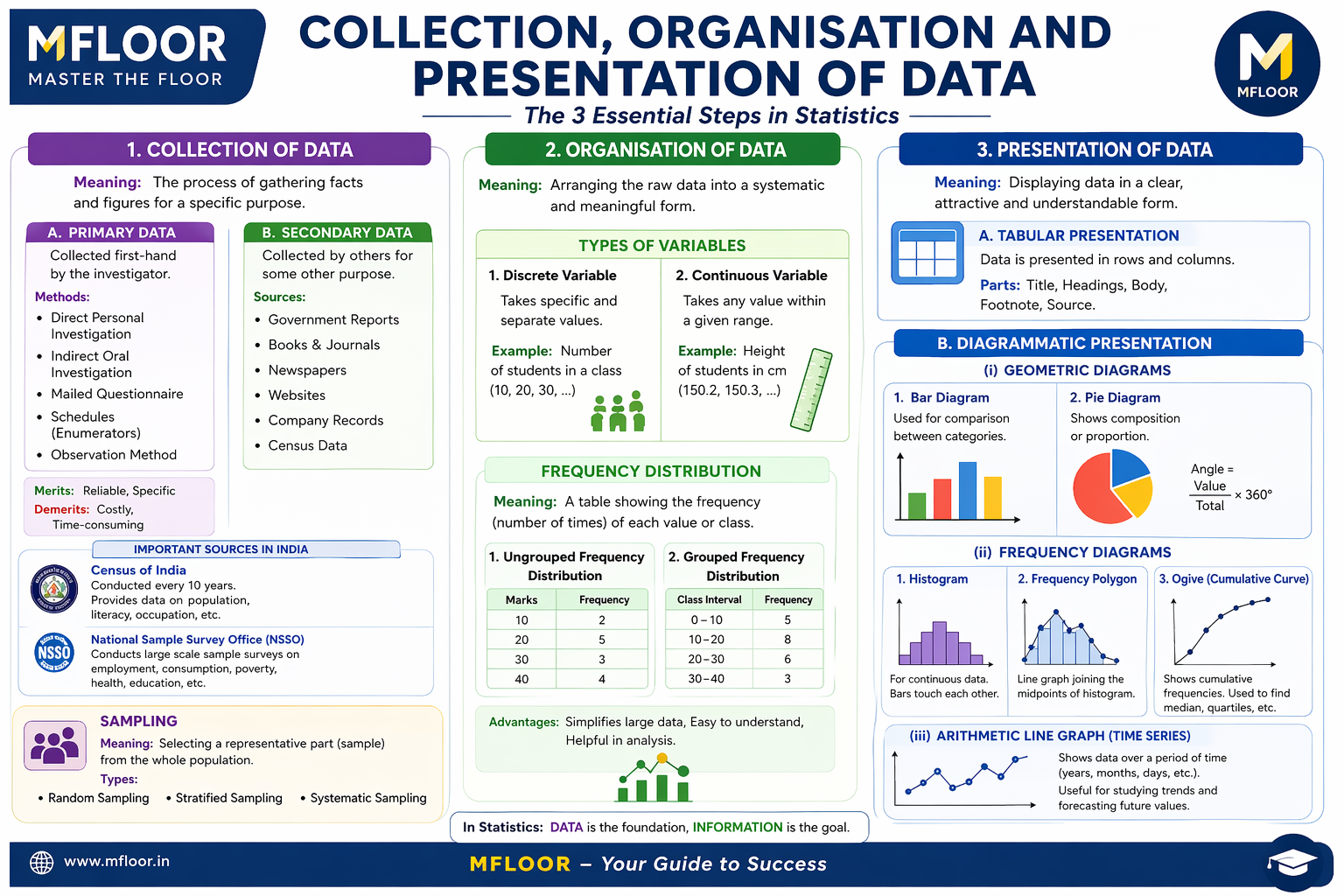
🔹 1. COLLECTION OF DATA
📌 Meaning
Collection of data is the first step in statistics, where relevant facts and figures are gathered for analysis. Without proper data, no meaningful conclusion can be drawn.
🔸 SOURCES OF DATA
🟢 (A) Primary Data
📌 Meaning:
Primary data is data collected originally by the investigator for a specific purpose.
📌 Features:
- Original and raw
- Collected for the first time
- More reliable and accurate
📌 Methods of Collecting Primary Data:
1. Direct Personal Investigation
- Investigator personally collects data from respondents
👉 Example: Asking students about their study hours
2. Indirect Oral Investigation
- Information collected from third parties
👉 Example: Asking villagers about a farmer’s income
3. Information through Correspondents
- Local agents send information regularly
👉 Used in newspapers
4. Mailed Questionnaire Method
- Questionnaires are sent by post/email
👉 Suitable for educated respondents
5. Schedules through Enumerators
- Trained persons collect data by interviewing
👉 Used in government surveys
6. Observation Method
- Data collected by observing behavior or events
👉 Example: Traffic counting
📊 Advantages of Primary Data:
- Highly reliable
- Specific to objective
- Up-to-date
❌ Disadvantages:
- Costly
- Time-consuming
- Requires manpower
🟡 (B) Secondary Data
📌 Meaning:
Secondary data is data already collected by others for some other purpose but used by the researcher.
📌 Sources of Secondary Data:
📚 Published Sources:
- Government reports
- Books, journals
- Websites
📁 Unpublished Sources:
- Company records
- Personal documents
🇮🇳 Important Indian Sources:
👉 Census of India
- Conducted every 10 years
- Provides detailed demographic data (population, literacy, etc.)
👉 National Sample Survey Office
- Conducts large-scale sample surveys
- Data on employment, consumption, poverty
📊 Advantages:
- Saves time and money
- Easily accessible
❌ Disadvantages:
- May be outdated
- May not suit the exact objective
🔸 SAMPLING
📌 Meaning:
Sampling is the process of selecting a representative portion of the population.
📌 Key Terms:
- Population (Universe) → Entire group
- Sample → Small part selected
📌 Types of Sampling:
- Random Sampling
- Equal chance for all
- Stratified Sampling
- Population divided into groups
- Systematic Sampling
- Selecting every nth item
📊 Importance of Sampling:
- Saves time
- Reduces cost
- Practical for large populations
🔹 2. ORGANISATION OF DATA
📌 Meaning:
Organisation means arranging raw data into a systematic and logical form.
Raw data is often confusing; organisation makes it understandable.
🔸 TYPES OF VARIABLES
1. Discrete Variables
- Take specific values only
👉 Example: Number of students (10, 20, 30)
2. Continuous Variables
- Can take any value within a range
👉 Example: Height (150.5 cm, 160.2 cm)
🔸 FREQUENCY DISTRIBUTION
📌 Meaning:
It is a table showing how many times each value occurs.
📌 Types:
1. Ungrouped Frequency Distribution
- Individual values listed with frequency
👉 Example:
| Marks | Frequency |
|---|---|
| 10 | 2 |
| 20 | 5 |
2. Grouped Frequency Distribution
- Data grouped into class intervals
👉 Example:
| Class Interval | Frequency |
|---|---|
| 0–10 | 5 |
| 10–20 | 8 |
📊 Advantages:
- Simplifies large data
- Helps in analysis
🔹 3. PRESENTATION OF DATA
📌 Meaning:
Presentation refers to displaying data in a clear, attractive, and understandable form.
🔸 (A) TABULAR PRESENTATION
📌 Meaning:
Data is arranged in rows and columns.
📌 Parts of Table:
- Title
- Headings
- Body
- Footnote
📊 Advantages:
- Easy comparison
- Systematic arrangement
🔸 (B) DIAGRAMMATIC PRESENTATION
📊 (i) GEOMETRIC DIAGRAMS
1. Bar Diagram
- Used for comparison
- Bars represent values
👉 Types:
- Simple bar
- Multiple bar
- Component bar
2. Pie Diagram
- Circular diagram
- Shows proportion
👉 Formula:
Angle = (Value / Total) × 360°
📈 (ii) FREQUENCY DIAGRAMS
1. Histogram
- Continuous data
- No gaps between bars
2. Frequency Polygon
- Line graph connecting midpoints
3. Ogive (Cumulative Curve)
- Shows cumulative frequency
👉 Helps find median
📉 (iii) ARITHMETIC LINE GRAPH (TIME SERIES)
📌 Meaning:
Shows data over time (days, months, years)
👉 Example:
- Population growth
- Sales trend
📊 Importance:
- Shows trends
- Helps in forecasting
✅ FINAL CONCLUSION
The three steps:
- Collection → Gathering data
- Organisation → Structuring data
- Presentation → Displaying data
Together, they transform raw facts into meaningful information, which is essential in economics, business, and decision-making.