


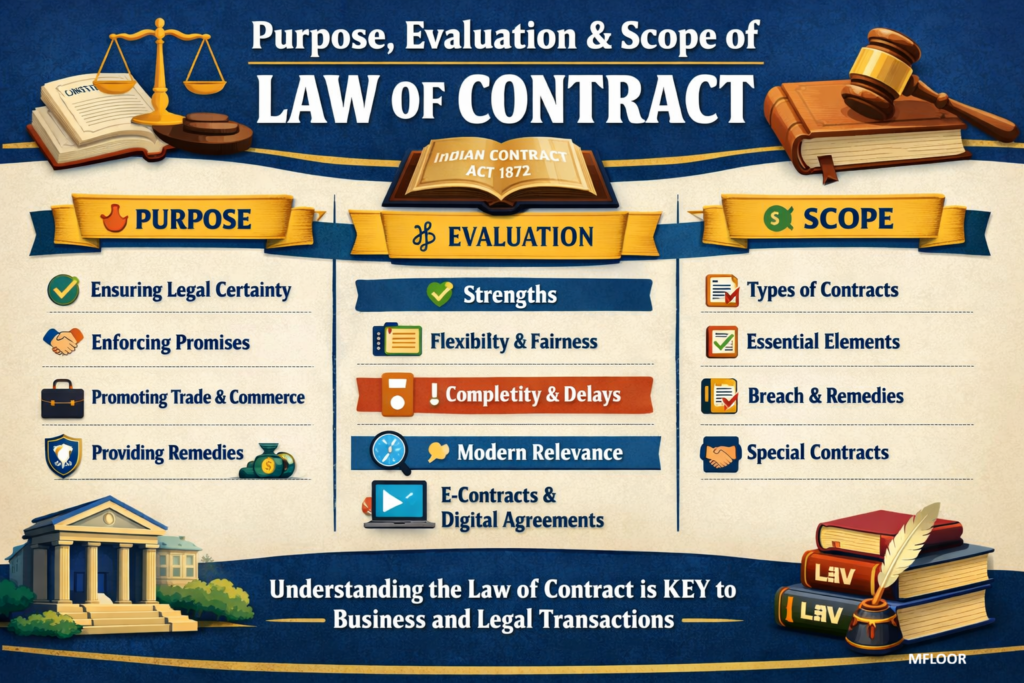
📘 Law of Contract: Purpose, Evaluation & Scope
🎯 Purpose of the Law of Contract
The law of contract (in India governed by the Indian Contract Act, 1872) serves several important purposes:
1. Ensuring Legal Certainty
It provides a clear framework so parties know their rights and obligations when entering agreements.
2. Enforcing Promises
Not all promises are binding, but the law ensures that legally enforceable agreements are honored.
3. Promoting Trade & Commerce
Contracts form the backbone of business transactions—buying, selling, employment, partnerships, etc.
4. Protecting Parties
It safeguards individuals and businesses against fraud, coercion, misrepresentation, and undue influence.
5. Providing Remedies
If a contract is broken, the law provides remedies such as damages, compensation, or specific performance.
⚖️ Evaluation of the Law of Contract
Evaluation refers to analyzing how effective and relevant the law is:
✔️ Strengths
- Flexibility: Allows parties to frame their own terms (freedom of contract).
- Wide Applicability: Covers almost all types of agreements.
- Fairness Principles: Protects weaker parties through doctrines like free consent.
❗ Limitations
- Complexity: Legal language and procedures can be difficult for common people.
- Time-Consuming Enforcement: Court cases may take years.
- Inequality of Bargaining Power: Stronger parties may dominate contracts (e.g., big companies vs consumers).
🔍 Modern Relevance
With digital transactions and e-commerce, contract law continues to evolve, including recognition of:
- E-contracts
- Digital signatures
- Online agreements
🌍 Scope of the Law of Contract
The scope defines the areas and situations where contract law applies:
1. Types of Contracts Covered
- Valid contracts
- Void and voidable contracts
- Express and implied contracts
- Quasi-contracts
2. Essential Elements
A contract must include:
- Offer and acceptance
- Lawful consideration
- Free consent
- Competent parties
- Lawful object
3. Performance & Discharge
Covers how contracts are performed, fulfilled, or terminated.
4. Breach of Contract
Deals with consequences when one party fails to perform.
5. Remedies
Includes:
- Damages
- Specific performance
- Injunction
6. Special Contracts
The law also governs specific types such as:
- Indemnity and guarantee
- Bailment and pledge
- Agency
🧾 Conclusion
The law of contract plays a vital role in maintaining trust and order in both personal and commercial relationships. While it has some limitations, its adaptability ensures it remains relevant in modern economic systems.