


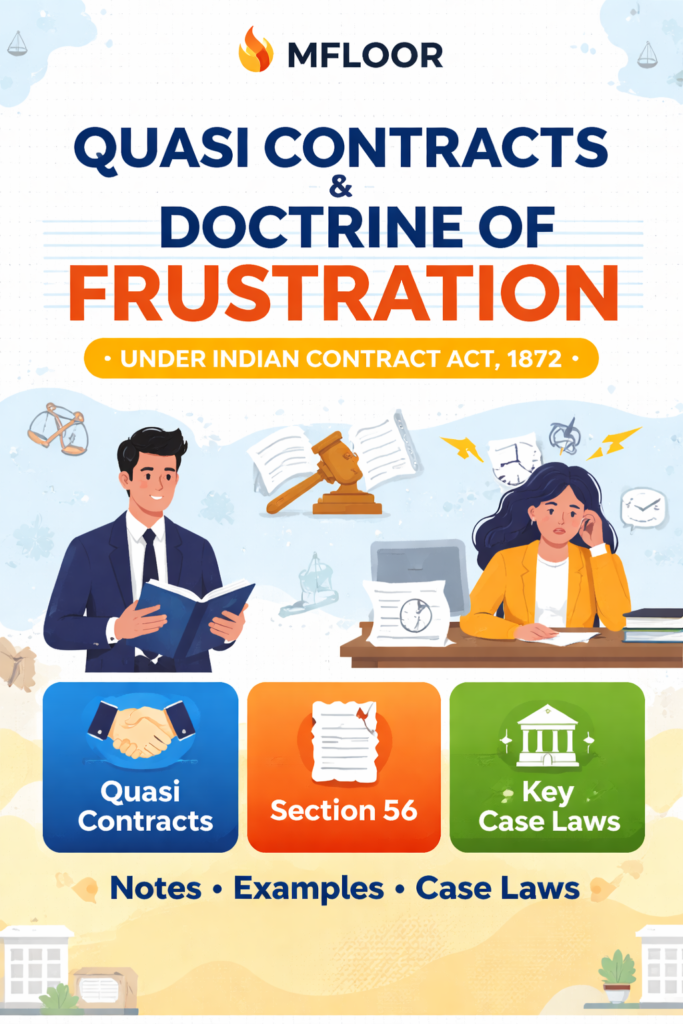
📘 Law Relating to Certain Relations Resembling Contracts (Quasi Contracts)
🔍 Meaning
Under the Indian Contract Act, 1872, certain obligations are imposed by law even without any agreement between parties. These are called Quasi-Contracts.
👉 They are not actual contracts but are treated as such to prevent unjust enrichment.
⚖️ Key Principle
📌 Based on the concept of
👉 Unjust Enrichment
“No person should benefit at the expense of another.”
🧾 Features of Quasi-Contracts
- No agreement or mutual consent 🤝❌
- Imposed by law ⚖️
- Based on equity, justice & good conscience
- Right to claim compensation 💰
📜 Types of Quasi-Contracts (Sections 68–72)
1️⃣ Supply of Necessaries (Section 68)
If a person supplies necessaries to someone incapable of contracting (like a minor), the supplier can recover the cost.
📌 Example: Supplying food or medicine to a minor.
2️⃣ Payment by Interested Person (Section 69)
A person who pays money on behalf of another, to protect his own interest, can claim reimbursement.
📌 Example: Paying someone else’s tax to prevent property loss.
3️⃣ Non-Gratuitous Act (Section 70)
If a person does something lawfully for another person, and the other person enjoys the benefit, compensation must be paid.
📌 Conditions:
- Lawful act
- Not intended to be free
- Benefit enjoyed
4️⃣ Finder of Lost Goods (Section 71)
A finder of goods has rights similar to a bailee.
📌 Duties:
- Take reasonable care
- Return goods to the owner
5️⃣ Money Paid by Mistake or Coercion (Section 72)
Money paid under mistake or coercion must be repaid.
📌 Example: Paying extra money due to calculation error.
⚡ Doctrine of Frustration (Section 56)
🔍 Meaning
The doctrine of frustration applies when a contract becomes impossible to perform or unlawful after it is made.
📌 Governed by Section 56 of the Indian Contract Act, 1872.
📊 Core Idea
A contract is discharged when:
- Performance becomes impossible
- The purpose of the contract is destroyed
⚖️ Legal Maxim
👉 Lex Non Cogit Ad Impossibilia
(Law does not compel a man to do what he cannot possibly perform)
🧠 Types of Impossibility
1️⃣ Initial Impossibility
- Exists at the time of contract formation
- Contract is void from the beginning
2️⃣ Supervening Impossibility (Frustration)
- Occurs after formation of contract
- Contract becomes void due to unforeseen events
⚠️ Grounds of Frustration
🌪️ 1. Destruction of Subject Matter
📌 Example: Goods destroyed by fire
⚰️ 2. Death or Incapacity
📌 Example: Personal service contract ends on death
🚫 3. Change in Law
📌 Example: Government bans the activity
🌍 4. Non-occurrence of Event
📌 Example: Event-based contract where event fails
🪖 5. Outbreak of War
📌 Example: Trade becomes illegal between countries
❌ When Frustration Does NOT Apply
- Difficulty or hardship 😓
- Commercial loss 📉
- Self-induced impossibility 🚫
- Foreseeable events 🔍
📌 Effects of Frustration
- Contract becomes void ⚖️
- Parties are discharged from obligations
- Governed by Section 65 for restitution
👉 Any benefit received must be returned or compensated
🧾 Important Case Laws
⚖️ Taylor v Caldwell
- Music hall destroyed by fire
- Contract became void due to impossibility
⚖️ Krell v Henry
- Room rented for coronation viewing
- Event cancelled → contract frustrated
⚖️ Satyabrata Ghose v Mugneeram Bangur & Co.
- Explained scope of frustration in India
🔗 Relation Between Quasi-Contract & Frustration
- Both aim at fairness and justice ⚖️
- Quasi-contract ensures no unjust benefit
- Frustration ensures no forced impossibility
📝 Conclusion
The Indian Contract Act, 1872 ensures justice even beyond formal contracts through quasi-contracts, while the doctrine of frustration protects parties from obligations that become impossible due to unforeseen circumstances.