
Here’s a clear and structured explanation of Formation of Contract – Essential Condition: Lawful Object & Lawful Consideration:
📘 Formation of Contract: Lawful Object and Lawful Consideration
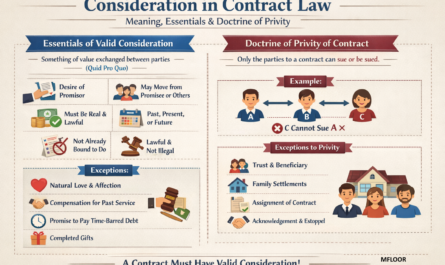
🔹 Meaning of Consideration
Consideration is the price paid by one party for the promise of the other. It is an essential element of a valid contract.
👉 According to Indian Contract Act, 1872 (Section 2(d)), consideration means:
“When at the desire of the promisor, the promisee or any other person has done or abstained from doing something…”
🔹 Meaning of Lawful Consideration and Object
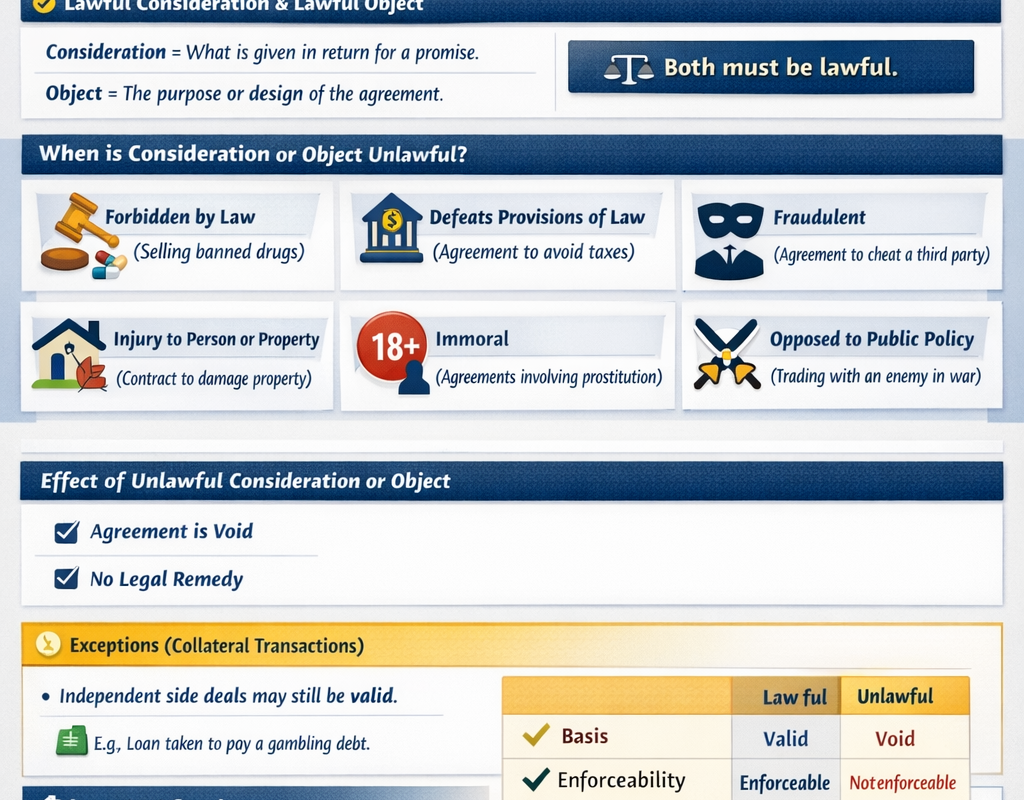
- Consideration = What is given in return for a promise
- Object = The purpose or design of the agreement
For a contract to be valid, both must be lawful.
👉 As per Indian Contract Act, 1872, consideration or object is lawful unless it is:
⚖️ When is Consideration or Object Unlawful?
A consideration or object is unlawful if it falls under any of the following categories:
1. Forbidden by Law
If the agreement involves something illegal or prohibited by law.
📌 Example: Selling banned drugs.
2. Defeats the Provisions of Law
If permitted, it would defeat the purpose of any law.
📌 Example: Agreement to avoid paying taxes.
3. Fraudulent
If the object or consideration involves fraud.
📌 Example: Agreement to cheat a third party.
4. Involves Injury to Person or Property
If it causes harm to someone or their property.
📌 Example: Contract to damage someone’s property.
5. Immoral
If it is against accepted moral standards.
📌 Example: Agreements involving prostitution.
6. Opposed to Public Policy
If it is harmful to society or public welfare.
📌 Example: Trading with an enemy during war.
🔹 Effect of Unlawful Consideration or Object
- The agreement becomes void (not enforceable by law).
- No legal remedy is available to either party.
🔹 Exceptions (Collateral Transactions)
Sometimes, even if the main agreement is unlawful, collateral transactions may still be valid if they are independent and lawful.
📌 Example: A loan taken to pay a gambling debt may be recoverable (depending on jurisdiction).
🔹 Key Differences: Lawful vs Unlawful
| Basis | Lawful | Unlawful |
|---|---|---|
| Legal Status | Valid | Void |
| Enforceability | Enforceable | Not enforceable |
| Nature | Permitted by law | Prohibited / harmful |
🔹 Important Case Law
📚 Gherulal Parakh v. Mahadeodas Maiya
- The Supreme Court explained the concept of public policy.
- Agreements opposed to public policy are void.
🔹 Conclusion
For a contract to be valid under the Indian Contract Act, 1872, both:
- Consideration and
- Object
must be lawful. If either is unlawful, the agreement is void and unenforceable.