


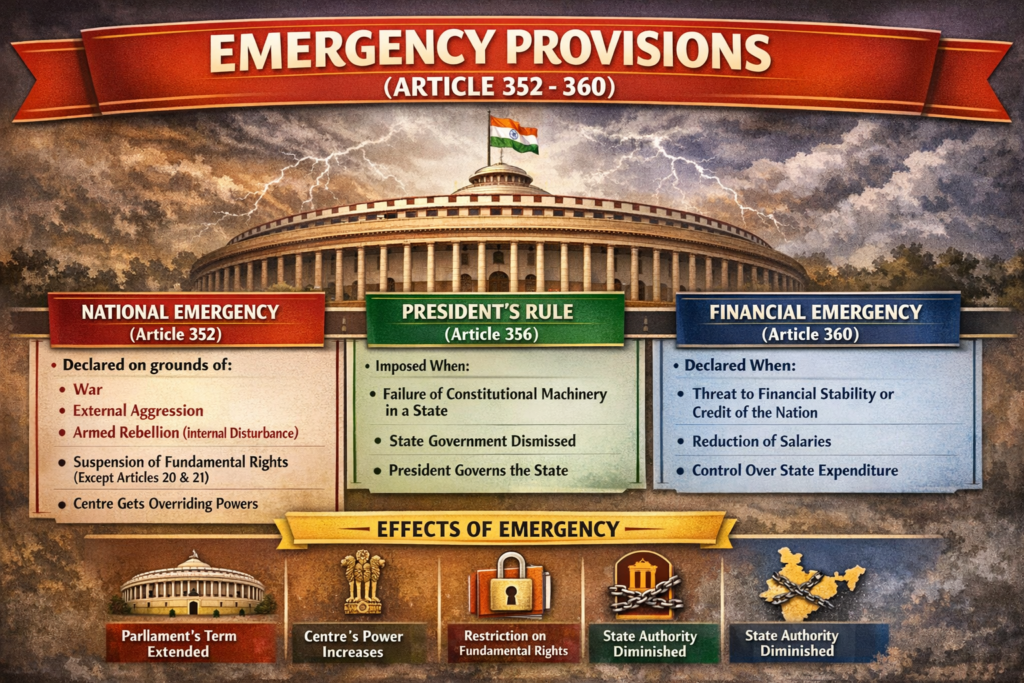
Here’s a simple and clear explanation of Emergency Provisions in India, with special focus on Proclamation of Emergency (National Emergency) and President’s Rule:
🇮🇳 Emergency Provisions in India (Articles 352–360)
Emergency provisions in the Constitution of India allow the central government to take special powers during abnormal situations like war, internal disturbance, or financial crisis.
There are 3 types of emergencies:
- National Emergency (Article 352)
- President’s Rule / State Emergency (Article 356)
- Financial Emergency (Article 360)
⚠️ 1. Proclamation of Emergency (National Emergency – Article 352)
📌 When is it declared?
The President can declare emergency when there is:
- War
- External aggression
- Armed rebellion (earlier called internal disturbance)
📌 Who declares it?
The President of India declares it on the written advice of the Cabinet.
📌 Parliamentary Approval
- Must be approved by both Houses of Parliament within 1 month
- If approved → continues for 6 months
- Can be extended repeatedly with approval
📌 Effects of National Emergency
1. On Central-State Relations
- Central government becomes very powerful
- Parliament can make laws on State List subjects
2. On Fundamental Rights
- Article 19 is automatically suspended (only in war/external aggression)
- Other rights can also be restricted (Article 359)
3. On Executive Power
- Union government can give directions to states
📌 Example
- Emergency declared in 1975 by Indira Gandhi (internal emergency)
🏛️ 2. President’s Rule (Article 356)
📌 What is it?
It is imposed when constitutional machinery in a state fails.
📌 When is it declared?
- If the Governor reports that the state government cannot function properly
- Or the President is satisfied that governance cannot be carried on as per the Constitution
📌 Who declares it?
- Declared by the President of India
📌 Parliamentary Approval
- Must be approved within 2 months
- Valid for 6 months
- Can be extended up to 3 years (with conditions)
📌 Effects of President’s Rule
1. State Government
- State government is dismissed
- Governor runs the state on behalf of the President
2. Legislature
- State Legislative Assembly may be:
- Dissolved OR
- Kept suspended
3. Parliament’s Role
- Parliament makes laws for the state
📌 Misuse Concern
Article 356 has often been misused for political reasons.
To control this, the Supreme Court gave an important judgment in:
👉 S.R. Bommai v. Union of India
- Limited misuse of President’s Rule
- Made it subject to judicial review
⚖️ Key Differences (Quick Comparison)
| Feature | National Emergency (Art 352) | President’s Rule (Art 356) |
|---|---|---|
| Area | Whole country or part | Specific state |
| Reason | War / aggression / rebellion | Failure of state government |
| Effect | Centre gets more power | State comes under Centre |
| Rights Impact | Fundamental rights affected | No direct effect on rights |
🧠 In Simple Words
- National Emergency = Country in danger → Centre becomes powerful
- President’s Rule = State government fails → Centre takes over state
Here are exam-ready short notes and a case laws summary on Emergency Provisions (focused on National Emergency & President’s Rule):
📝 SHORT NOTES (Quick Revision)
⚠️ National Emergency (Article 352)
- Declared by the President under the Constitution of India
- Grounds: War, External Aggression, Armed Rebellion
- Requires written advice of Cabinet
- Approval: Within 1 month by Parliament
- Duration: 6 months (extendable)
🔑 Effects:
- Centre gets control over states
- Parliament can legislate on State List
- Fundamental Rights:
- Article 19 suspended (only in war/external aggression)
- Other rights can be restricted (Art 359)
📌 Important Point:
- 44th Amendment replaced “internal disturbance” with armed rebellion
🏛️ President’s Rule (Article 356)
- Imposed when state machinery fails
- Based on Governor’s report or President’s satisfaction
🔑 Features:
- State government dismissed
- Governor administers state
- Parliament makes laws
⏳ Duration:
- Approval within 2 months
- Valid for 6 months, extendable up to 3 years
⚖️ Financial Emergency (Article 360) (very short)
- Declared during financial instability
- Never imposed in India so far
- Centre can reduce salaries, control finances
⚖️ CASE LAWS SUMMARY
1. S.R. Bommai v. Union of India
Most important case on Article 356
🔑 Key Judgments:
- President’s Rule is subject to judicial review
- Cannot be used for political misuse
- Majority must be tested on floor of the House, not by Governor
- Secularism is a basic feature → violation can justify President’s Rule
2. ADM Jabalpur v. Shivkant Shukla
During 1975 Emergency
🔑 Key Points:
- Right to move courts for enforcement of Fundamental Rights was suspended
- Widely criticized decision
- Later corrected by judiciary (rights are now better protected)
3. Minerva Mills v. Union of India
🔑 Key Points:
- Limited the power of Parliament during Emergency
- Reinforced Basic Structure Doctrine
- Balance between Fundamental Rights & Directive Principles
4. Kesavananda Bharati v. State of Kerala
🔑 Key Points:
- Introduced Basic Structure Doctrine
- Parliament cannot destroy core features of Constitution
- Important for limiting Emergency powers indirectly
🧠 One-Line Revision
- Art 352 → National crisis → Centre dominates
- Art 356 → State failure → President takes over
- Bommai Case → Stops misuse of President’s Rule
- ADM Jabalpur → Dark phase of rights
- Minerva Mills / Kesavananda → Protect Constitution’s core