
Here’s a clear and structured explanation of Consideration as an essential element of contract formation, along with the Doctrine of Privity of Contract:
📘 Formation of Contract: Consideration
🔹 Meaning of Consideration
Consideration is one of the most important elements for a valid contract. It refers to something of value given by both parties to a contract.
👉 According to the Indian Contract Act, 1872 (Section 2(d)):
When, at the desire of the promisor, the promisee or any other person has done or abstained from doing something, such act or abstinence is called consideration.
✔️ In simple terms:
Consideration means “something in return” (quid pro quo).
Without consideration, a contract is generally not enforceable.
🔹 Essential Conditions of Valid Consideration
For consideration to be legally valid, it must satisfy the following conditions:
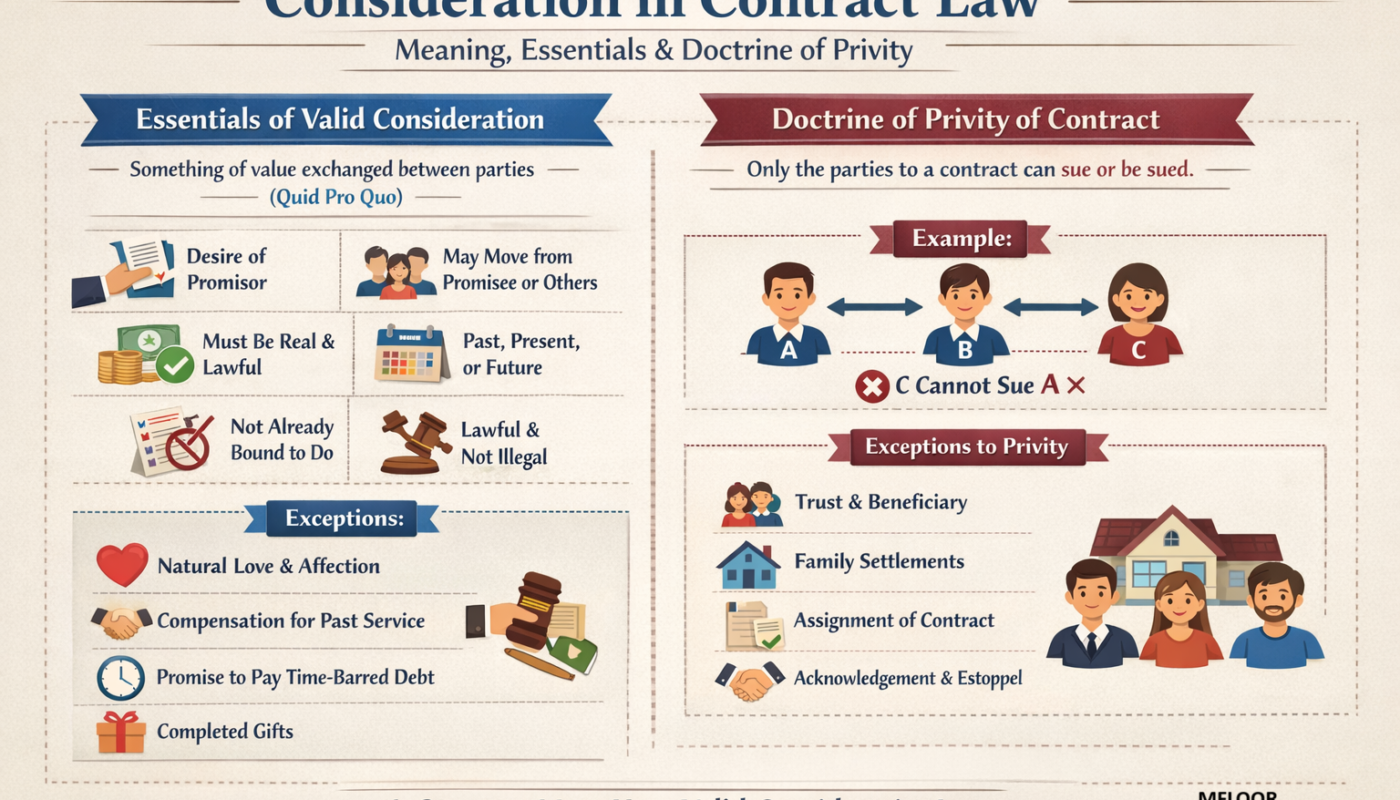
1. Must Move at the Desire of the Promisor
The act or abstinence must be done at the request of the promisor, not voluntarily.
2. May Move from Promisee or Any Other Person
Under Indian law, consideration can be provided by the promisee or even a third party.
3. Must Be Real and Not Illusory
Consideration must have some value in the eyes of law (though it need not be adequate).
4. Need Not Be Adequate
Courts do not question the adequacy of consideration, but it must be real and lawful.
5. Must Be Lawful
Consideration should not be:
- Illegal
- Immoral
- Against public policy
6. May Be Past, Present, or Future
- Past Consideration: Already done before the promise
- Present Consideration: Done at the time of contract
- Future Consideration: To be done in the future
7. Must Not Be Something the Promisee Is Already Bound to Do
A pre-existing legal duty cannot be valid consideration.
🔹 Exceptions: When Consideration Is Not Required
Under the Indian Contract Act, 1872, agreements without consideration are void, except in certain cases:
- Agreement made out of natural love and affection (between close relatives)
- Promise to compensate for past voluntary services
- Promise to pay a time-barred debt
- Completed gifts
- Agency contracts
📘 Doctrine of Privity of Contract
🔹 Meaning
The doctrine of privity of contract means that:
👉 Only the parties to a contract can sue or be sued on it.
A third party, even if benefited by the contract, cannot enforce it.
🔹 Key Principle
- Contract creates rights and obligations only between parties.
- A stranger to the contract has no legal rights.
🔹 Example
If A makes a contract with B to pay money to C:
- C (a third party) cannot sue A, even though he benefits.
🔹 Exceptions to the Doctrine of Privity
Indian law recognizes several exceptions where a third party can sue:
1. Trust or Beneficiary
A beneficiary under a trust can enforce the contract.
2. Family Settlement / Marriage Agreements
Third parties (like family members) can enforce such agreements.
3. Assignment of Contract
Rights transferred to a third party can be enforced by them.
4. Acknowledgement or Estoppel
If a party acknowledges liability to a third person, they may be bound.
5. Agency
A principal can enforce contracts made by an agent.
6. Charge on Immovable Property
A person with a charge (interest) may enforce rights.
✅ Conclusion
Consideration is the backbone of a valid contract—it ensures that agreements are based on mutual exchange. Alongside, the doctrine of privity limits enforcement to parties involved, though Indian law provides practical exceptions to protect fairness and justice.