
📘 Formation of Contract: Consent and Free Consent
🔹 Meaning of Consent
Under the Indian Contract Act, 1872, consent is defined in Section 13.
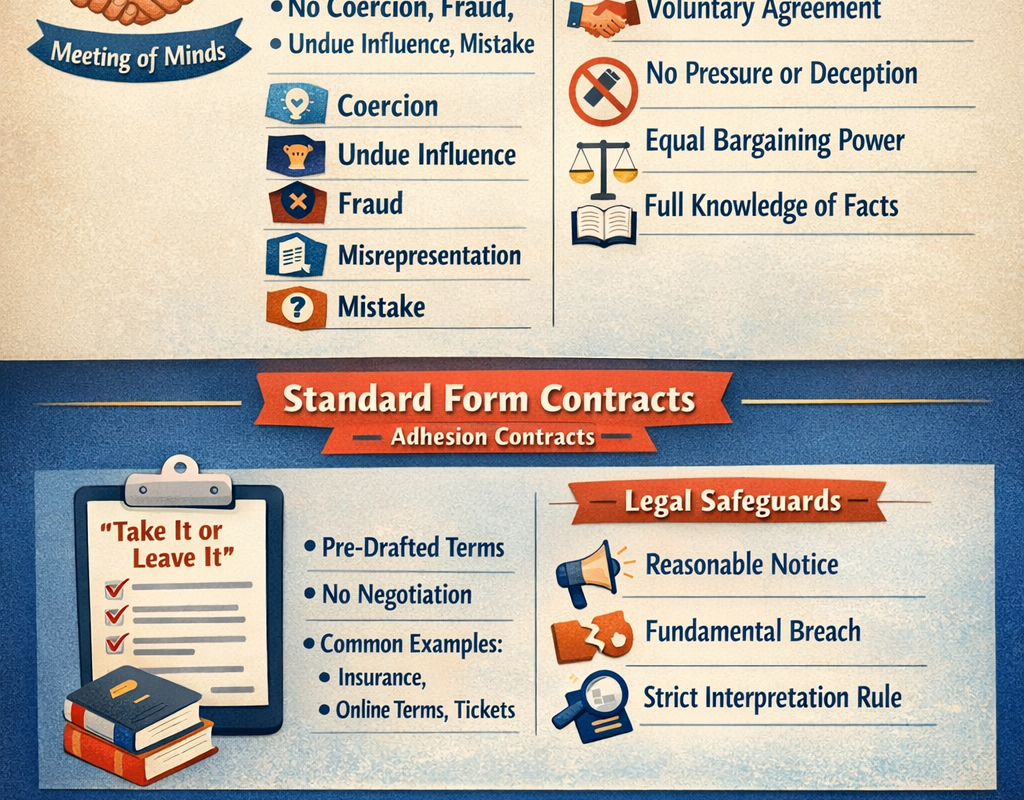
👉 Two or more persons are said to consent when they agree upon the same thing in the same sense.
This is often expressed by the Latin phrase:
“Consensus ad idem” (meeting of minds)
✔️ Example:
If A agrees to buy B’s car thinking it is a new car, but B is selling an old car, there is no consent because both parties are not thinking about the same thing.
🔹 Meaning of Free Consent
According to Section 14 of the Indian Contract Act, 1872, consent is said to be free when it is not caused by:
- Coercion
- Undue Influence
- Fraud
- Misrepresentation
- Mistake
If consent is affected by any of these, the contract becomes voidable or void.
🔹 Elements Affecting Free Consent
1. Coercion (Section 15)
Committing or threatening to commit any act forbidden by law to force someone into a contract.
👉 Example: Threatening someone to sign an agreement.
2. Undue Influence (Section 16)
When one party dominates the will of another and uses that position to obtain an unfair advantage.
👉 Example: Doctor influencing a patient to enter a contract.
3. Fraud (Section 17)
Intentional deception to induce another party into a contract.
👉 Example: Selling fake goods as genuine.
4. Misrepresentation (Section 18)
False statement made without intent to deceive.
👉 Example: Providing incorrect information believing it to be true.
5. Mistake (Sections 20–22)
An erroneous belief about facts.
- Bilateral Mistake → Contract is void
- Unilateral Mistake → Contract usually valid
🔹 Essential Conditions of Free Consent
For consent to be considered free:
✔️ It must be given voluntarily
✔️ It must not be obtained by pressure or deception
✔️ Parties must have equal bargaining power
✔️ There must be full knowledge of facts
🔹 Standard Form Contracts (Adhesion Contracts)
📌 Meaning
A standard form contract is a pre-drafted contract where one party sets all terms, and the other party has little or no ability to negotiate.
👉 Common in:
- Insurance policies
- Online terms & conditions
- Railway/airline tickets
📌 Characteristics
✔️ Prepared by one party
✔️ Printed or digital format
✔️ “Take it or leave it” basis
✔️ No negotiation
📌 Legal Position
Courts ensure fairness in such contracts by applying:
1. Doctrine of Reasonable Notice
The terms must be properly communicated.
2. Doctrine of Fundamental Breach
Important terms cannot be unfairly excluded.
3. Strict Interpretation Rule
Ambiguous terms are interpreted against the drafter.
📌 Example
When you accept terms on apps like Paytm or Amazon, you are entering a standard form contract.
🔹 Conclusion
Consent is the foundation of a valid contract, but it must be free and genuine. If consent is obtained through coercion, fraud, or other unfair means, the contract loses its validity. In modern commerce, standard form contracts are common, but the law protects individuals from unfair terms.