
📘 Formation of Contract: Capacity to Contract (Including Minor’s Agreement)
🔹 Meaning of Capacity to Contract
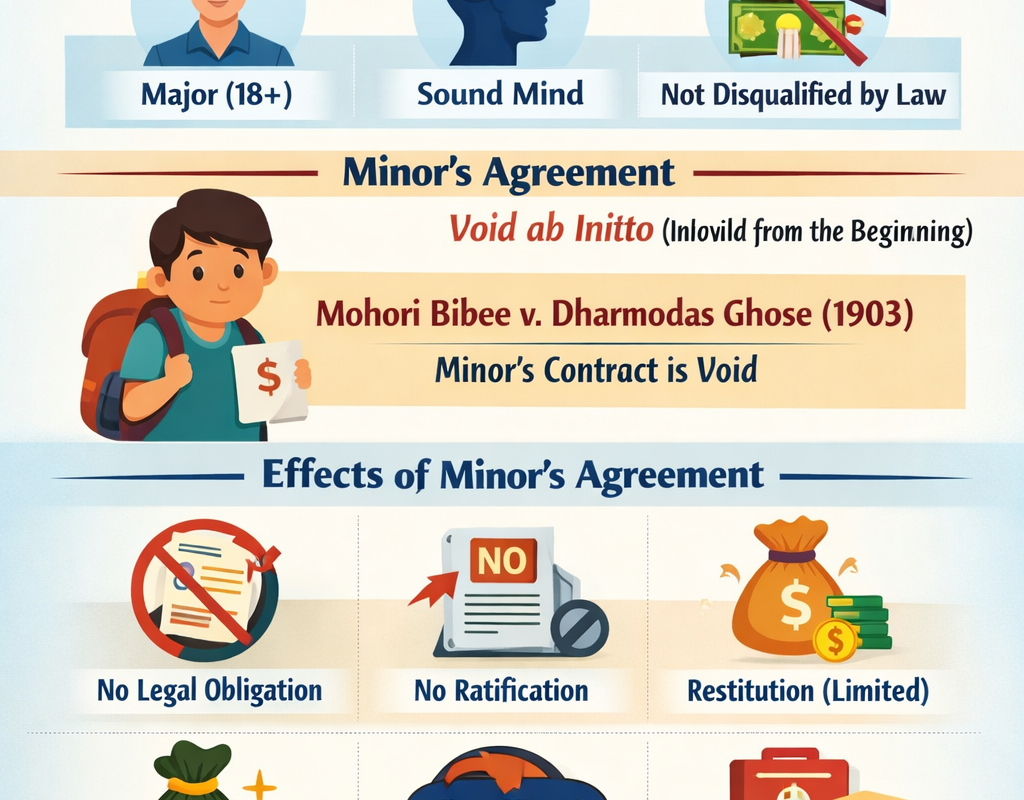
Capacity to contract refers to the legal ability of a person to enter into a valid and enforceable agreement. According to Section 11 of the Indian Contract Act, 1872, a person is competent to contract if they:
- Are of the age of majority
- Are of sound mind
- Are not disqualified from contracting by any law
🔹 Who are Competent to Contract?
1. 👤 Major (Adult)
A person who has attained the age of 18 years (or 21 in certain cases) is considered a major and is competent to contract.
2. 🧠 Person of Sound Mind
A person is said to be of sound mind if they:
- Understand the contract
- Can form a rational judgment about its effects on their interests
3. 🚫 Not Disqualified by Law
Certain persons are disqualified from contracting, such as:
- Alien enemies
- Insolvents
- Convicts (in some cases)
🔹 Minor’s Agreement
📌 Who is a Minor?
A minor is a person who has not attained the age of 18 years under Indian law.
🔹 Nature of Minor’s Agreement
👉 A minor’s agreement is void ab initio (void from the beginning).
This principle was established in the famous case:
- Mohori Bibee v. Dharmodas Ghose (1903)
In this case, the court held that a minor’s contract is absolutely void and unenforceable.
🔹 Effects of Minor’s Agreement
1. ❌ No Legal Obligation
A minor is not bound by any agreement they enter into.
2. ⚖️ No Ratification
A minor cannot ratify (confirm) the agreement after attaining majority.
3. 🔁 Restitution (Limited)
- If a minor has received benefits, the court may order restitution (return of property),
- But only if the property is still in possession of the minor.
4. 🤝 Minor as a Beneficiary
A minor can enforce a contract if it is for their benefit.
👉 Example: A minor can sue to recover money due under a contract made for their benefit.
5. 🛑 No Estoppel
A minor cannot be prevented from pleading minority, even if they misrepresented their age.
6. 🧾 No Liability for Necessaries
However, under Section 68:
- A minor is liable for necessaries supplied,
- But payment is made from the minor’s property, not personal liability.
7. 👥 No Partnership
A minor cannot be a partner in a firm, but can be admitted to the benefits of partnership.
8. 🔒 No Specific Performance
Contracts with minors cannot be specifically enforced against them.
🔹 Exceptions / Special Cases
- Contracts for necessaries (food, clothing, education, medical aid)
- Beneficial contracts (e.g., scholarship, apprenticeship)
🔹 Key Takeaways
- Capacity is essential for a valid contract
- Minor’s agreements are void from the beginning
- Law protects minors from exploitation
- However, minors can enforce contracts that benefit them