

Proxima Centauri : The Closest Star to Earth That Could Change Our Understanding of the Universe
When people look up at the night sky, they often imagine distant galaxies, mysterious planets, and stars too far away to ever reach. But hidden in the southern sky is a star that has fascinated astronomers for decades because it is surprisingly close to Earth. That star is Proxima Centauri.
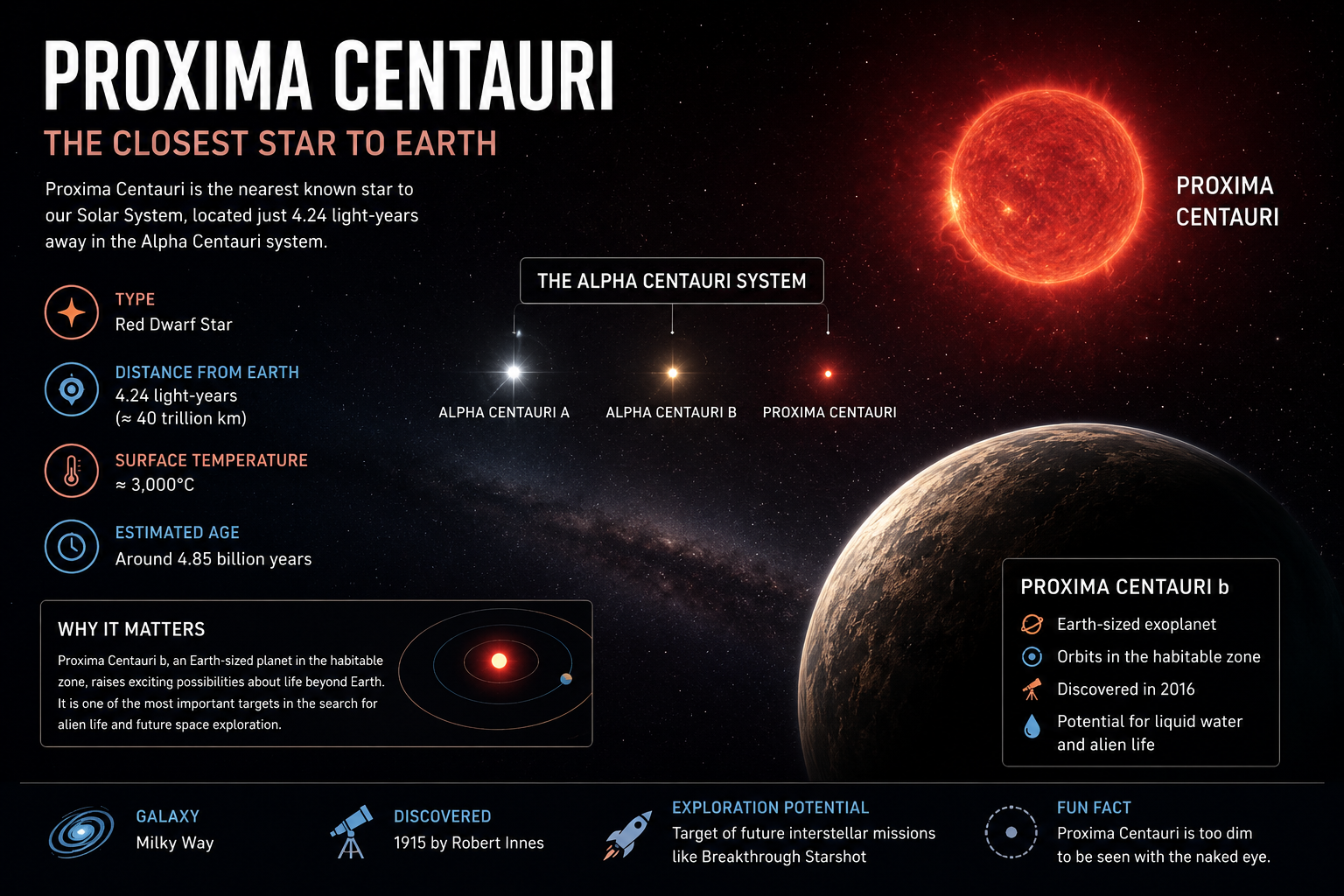
Located just over four light-years away, Proxima Centauri is the nearest known star beyond our Sun. Despite being our cosmic neighbor, it remained undiscovered until the early 20th century because of its faint glow. Today, it is one of the most studied stars in astronomy and a major focus in the search for alien life.
What Is Proxima Centauri?
Proxima Centauri is a small red dwarf star that belongs to the larger Alpha Centauri star system. The system includes two brighter stars, Alpha Centauri A and Alpha Centauri B, while Proxima Centauri orbits much farther away from them.
Unlike the Sun, Proxima Centauri is cooler, smaller, and far less luminous. In fact, it is so dim that it cannot be seen with the naked eye from Earth. Astronomers classify it as a red dwarf, which is the most common type of star in the Milky Way galaxy.
Although red dwarfs are smaller than stars like the Sun, they can survive for trillions of years because they burn their fuel very slowly. This makes Proxima Centauri a fascinating object for scientists studying how stars evolve over time.
How Far Away Is Proxima Centauri?
Proxima Centauri is approximately 4.24 light-years away from Earth. While that distance sounds small in astronomical terms, it is still incredibly far by human standards.
To understand the scale, consider this:
- One light-year equals about 9.46 trillion kilometers.
- A spacecraft traveling at current speeds would take tens of thousands of years to reach it.
- Even the fastest human-made objects would need centuries to arrive.
Because of this enormous distance, Proxima Centauri represents both hope and challenge for future space exploration.
Why Scientists Are Obsessed With Proxima Centauri
The biggest reason Proxima Centauri attracts attention is the discovery of planets orbiting the star. In 2016, astronomers confirmed the existence of Proxima Centauri b, an Earth-sized exoplanet located in the star’s habitable zone.
The habitable zone is the region around a star where temperatures may allow liquid water to exist on a planet’s surface. Since water is considered essential for life, this discovery immediately sparked global excitement.
Researchers believe Proxima Centauri b could potentially have:
- Rocky terrain
- An atmosphere
- Oceans or ice
- Conditions suitable for microbial life
However, there is also a major problem.
The Dangerous Side of Proxima Centauri
While Proxima Centauri may host potentially habitable planets, the star itself is highly active. It frequently releases massive stellar flares that emit dangerous radiation.
These flares can:
- Strip away planetary atmospheres
- Damage surface conditions
- Make survival difficult for living organisms
Scientists are still debating whether life could survive in such an extreme environment. Some theories suggest life may exist underground or underwater to avoid radiation exposure.
This uncertainty is exactly why Proxima Centauri continues to dominate scientific discussions about extraterrestrial life.
Could Humans Ever Travel There?
The idea of visiting Proxima Centauri has inspired scientists, engineers, and science-fiction writers for generations. Several advanced concepts have already been proposed for interstellar travel.
One of the most ambitious projects is Breakthrough Starshot, an initiative aiming to send tiny light-powered spacecraft toward the Alpha Centauri system at unprecedented speeds.
If successful, future missions could:
- Capture images of exoplanets
- Analyze atmospheres
- Search for signs of life
- Reveal details about nearby star systems
Although human travel to Proxima Centauri remains impossible with current technology, rapid advancements in space engineering continue to fuel optimism.
What Makes Proxima Centauri Important?
Proxima Centauri matters because it changes the way humanity thinks about the universe.
For centuries, stars appeared unreachable. But discovering potentially Earth-like planets around our nearest stellar neighbor has made the possibility of life beyond Earth feel more realistic than ever before.
It also reminds scientists that habitable worlds may exist throughout the galaxy, especially around red dwarf stars, which are extremely common.
As telescopes become more powerful and future missions expand deeper into space, Proxima Centauri will likely remain at the center of humanity’s search for another world.
Final Thoughts
Proxima Centauri may be tiny compared to the Sun, but its scientific importance is enormous. It represents the closest opportunity to study another star system in detail and possibly uncover evidence of alien life.
Every new discovery about this nearby star pushes astronomy into a new era. Whether scientists eventually find oceans, atmospheres, or signs of life around its planets, Proxima Centauri has already changed humanity’s understanding of what may exist beyond our solar system.




While the title promises a deep dive into Proxima Centauri’s hidden secrets, the article content heavily focuses on real estate listings in Jharkhand and West Bengal, which seems like an unexpected contrast. It would be fascinating to see future posts that actually explore the astronomy topic given by the headline, perhaps discussing the star’s flares or potential habitability.
well said. next target is Alpha Centauri.
It’s fascinating to explore Proxima Centauri as our next-door cosmic neighbor, especially given the potential for hidden secrets like the star being a binary or trinary system. While this astronomical topic is intriguing, it’s quite a departure from the real estate and web design services listed in the site’s navigation menu. Perhaps the site will feature space exploration content alongside their property listings to truly broaden the blog’s horizon!