

🌌 What is Galaxy? A Detailed Guide to the Universe’s Grand Structures
When you look up at the night sky, the tiny twinkling stars you see are just a fraction of something unimaginably vast. These stars, along with gas, dust, and mysterious dark matter, come together to form enormous systems known as galaxies. Understanding galaxies helps us uncover the story of the universe itself.
🌠 What is Galaxy?
A galaxy is a massive collection of stars, planets, gas, dust, and dark matter bound together by gravity. These cosmic systems can contain millions to trillions of stars and stretch across vast distances in space.
One of the most well-known galaxies is our own home, the Milky Way, which contains our solar system and billions of other stars.
🧩 Components of a Galaxy
Galaxies are not just clusters of stars—they are complex systems made up of several key elements:
⭐ 1. Stars
Stars are the fundamental building blocks of galaxies. Each galaxy can have billions of them, ranging from small, dim stars to massive, bright ones.
🪐 2. Planetary Systems
Many stars have planets orbiting them, just like our solar system.
🌫️ 3. Interstellar Medium
This includes gas (mostly hydrogen and helium) and cosmic dust, which are essential for forming new stars.
🕳️ 4. Black Holes
Most galaxies, including the Milky Way, have a supermassive black hole at their center.
🌌 5. Dark Matter
An invisible substance that makes up a large portion of a galaxy’s mass and influences its gravitational behavior.
🔭 Types of Galaxies
Astronomers classify galaxies based on their shapes and structures:
🌀 1. Spiral Galaxies
These galaxies have a flat, rotating disk with spiral arms.
Example: Milky Way
🔵 2. Elliptical Galaxies
They are round or oval-shaped and contain older stars.
🌫️ 3. Irregular Galaxies
These lack a defined shape and often appear chaotic.
🌍 How Big Are Galaxies?
Galaxies are enormous. For example, the Milky Way is about 100,000 light-years across. A light-year is the distance light travels in one year—about 9.46 trillion kilometers!
🌌 How Do Galaxies Form?
Galaxies formed billions of years ago from clouds of gas and dust after the Big Bang. Gravity pulled matter together, forming stars and eventually galaxies.
Over time, galaxies can collide and merge, growing larger and changing shape.
🚀 Famous Galaxies
Here are some well-known galaxies:
- Andromeda Galaxy – The closest large galaxy to the Milky Way.
- Triangulum Galaxy – A smaller spiral galaxy near Andromeda.
- Milky way Galaxy – Barred spiral galaxy that contains our solar system.
🌟 Detailed Study of Important Galaxies
Now let’s explore three of the most important galaxies in detail:
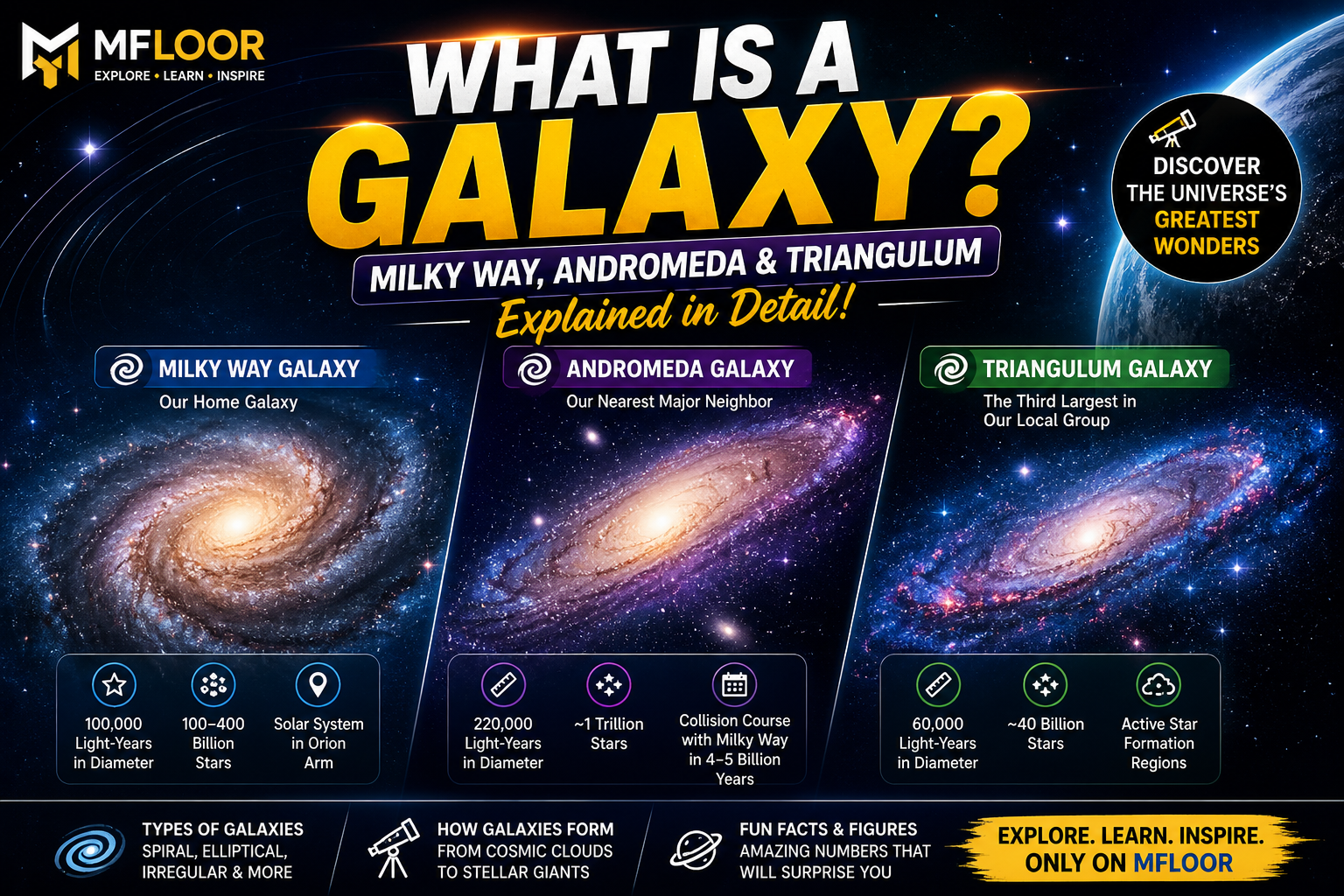
🌌 1. The Milky Way
🧭 Overview
The Milky Way is a barred spiral galaxy that contains our solar system. It appears as a glowing band of light in the night sky.
📏 Size & Structure
- Diameter: About 100,000–120,000 light-years
- Stars: 100–400 billion stars
- Structure: Spiral arms with a central bar
🕳️ Galactic Center
At its core lies a supermassive black hole called Sagittarius A*.
🌍 Our Position
Our solar system is located in the Orion Arm, about 27,000 light-years from the center.
🔄 Movement
The Milky Way rotates slowly; our solar system takes about 225–250 million years to complete one orbit.
🌌 2. The Andromeda Galaxy
🧭 Overview
The Andromeda Galaxy is the closest large galaxy to the Milky Way and is visible to the naked eye under dark skies.
📏 Size & Scale
- Diameter: About 220,000 light-years (larger than Milky Way)
- Stars: Around 1 trillion stars
🌠 Structure
It is also a spiral galaxy, similar in shape to the Milky Way but bigger.
🚀 Distance from Earth
Approximately 2.5 million light-years away.
💥 Future Collision
Andromeda is moving toward the Milky Way and is expected to collide with it in about 4–5 billion years, forming a new galaxy often called “Milkomeda.”
🌌 3. The Triangulum Galaxy
🧭 Overview
The Triangulum Galaxy is the third-largest galaxy in our local group, after the Milky Way and Andromeda.
📏 Size & Features
- Diameter: About 60,000 light-years
- Stars: Around 40 billion stars
🌟 Unique Characteristics
- Known for active star formation
- Contains large nebulae (star-forming regions)
🌌 Location
It lies about 3 million light-years from Earth and is gravitationally linked to the Andromeda Galaxy.
🌐 The Local Group
All three galaxies—the Milky Way, Andromeda Galaxy, and Triangulum Galaxy—are part of a cluster called the Local Group, which contains over 50 galaxies bound by gravity.
🚀 Why These Galaxies Matter
Studying these galaxies helps scientists:
- Understand galaxy formation and evolution
- Predict future cosmic events (like galaxy collisions)
- Explore dark matter and black holes
- Learn about star formation processes
🧠 Fun Facts
- The Andromeda Galaxy can be seen without a telescope in clear skies.
- The Milky Way looks like a milky band across the sky.
- The Triangulum Galaxy is one of the most active star-forming galaxies nearby.
✨ Conclusion
Galaxies are vast, complex systems that shape our universe. The Milky Way is just our starting point, while the Andromeda Galaxy and Triangulum Galaxy offer a glimpse into the dynamic and ever-changing nature of the cosmos.
Together, they remind us that we are part of something incredibly vast—and still largely mysterious.



I really enjoyed this post—it’s a clear and accessible introduction to galaxies. I’d be curious to read more about how the Milky Way, Andromeda, and Triangulum interact with each other over time, as that dynamic adds an extra layer of fascination.