
📘 Introduction
The law of torts is one of the most dynamic branches of civil law. It deals with wrongful acts that cause harm or injury to a person, their property, or reputation, and provides remedies in the form of compensation. Unlike criminal law, which punishes offenders, tort law focuses on compensating the victim and restoring their rights.
⚖️ What is a Tort? (Definition)
The term tort is derived from the Latin word “tortum”, meaning “to twist” or “wrong.” In legal terms, it refers to a civil wrong.
👉 Definition:
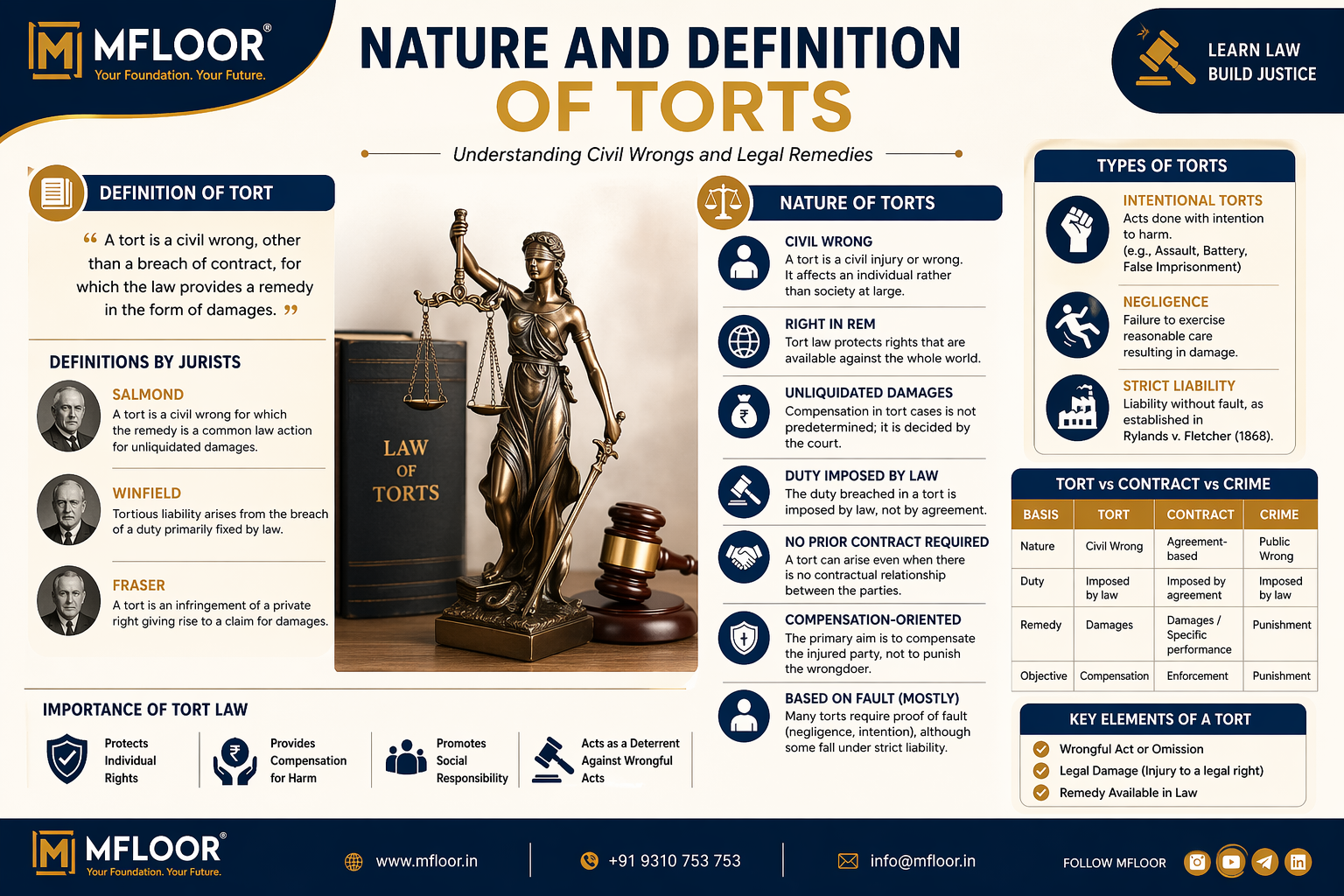
A tort is a civil wrong, other than a breach of contract, for which the law provides a remedy in the form of damages.
📖 Important Definitions by Jurists:
- Salmond:
“A tort is a civil wrong for which the remedy is a common law action for unliquidated damages.” - Winfield:**
“Tortious liability arises from the breach of a duty primarily fixed by law.” - Fraser:**
“A tort is an infringement of a private right giving rise to a claim for damages.”
🌱 Nature of Torts
The nature of tort law can be understood through its essential characteristics:
1️⃣ Civil Wrong
A tort is a civil injury or wrong. It affects an individual rather than society at large.
2️⃣ Right in Rem
Tort law protects rights that are available against the whole world (e.g., right to safety, reputation, property).
3️⃣ Unliquidated Damages
The compensation in tort cases is not predetermined. It is decided by the court depending on the facts and severity of harm.
4️⃣ Duty Imposed by Law
The duty breached in a tort is imposed by law, not by agreement between parties.
5️⃣ No Prior Contract Required
A tort can arise even when there is no contractual relationship between the parties.
6️⃣ Compensation-Oriented
The primary aim of tort law is to compensate the injured party rather than punish the wrongdoer.
7️⃣ Based on Fault (Mostly)
Many torts require proof of fault (negligence, intention), although some fall under strict liability.
🌍 Types of Torts
To understand its nature better, torts can be broadly classified into:
🔹 Intentional Torts
Acts done with intention to harm (e.g., assault, battery, false imprisonment).
🔹 Negligence
Failure to exercise reasonable care resulting in damage.
🔹 Strict Liability
Liability without fault, as established in the famous case of Rylands v. Fletcher.
⚖️ Distinction Between Tort and Other Wrongs
| Basis | Tort | Contract | Crime |
|---|---|---|---|
| Nature | Civil Wrong | Agreement-based | Public Wrong |
| Duty | Imposed by law | Imposed by agreement | Imposed by law |
| Remedy | Damages | Damages/Specific performance | Punishment |
| Objective | Compensation | Enforcement | Punishment |
🧠 Key Elements of a Tort
To establish a tort, the following elements must exist:
- Wrongful Act or Omission
- Legal Damage (Injury to a legal right)
- Remedy Available in Law
📌 Importance of Tort Law
- Protects individual rights
- Provides compensation for harm
- Promotes social responsibility
- Acts as a deterrent against wrongful acts
🏁 Conclusion
The law of torts plays a vital role in maintaining balance in society by ensuring that individuals are held accountable for their wrongful actions. Its flexible and evolving nature allows it to adapt to new situations, making it an essential part of modern legal systems. Understanding the nature and definition of torts is the foundation for exploring more complex legal concepts in civil law.