
📜 REMEDIES UNDER INDIAN CONTRACT ACT, 1872
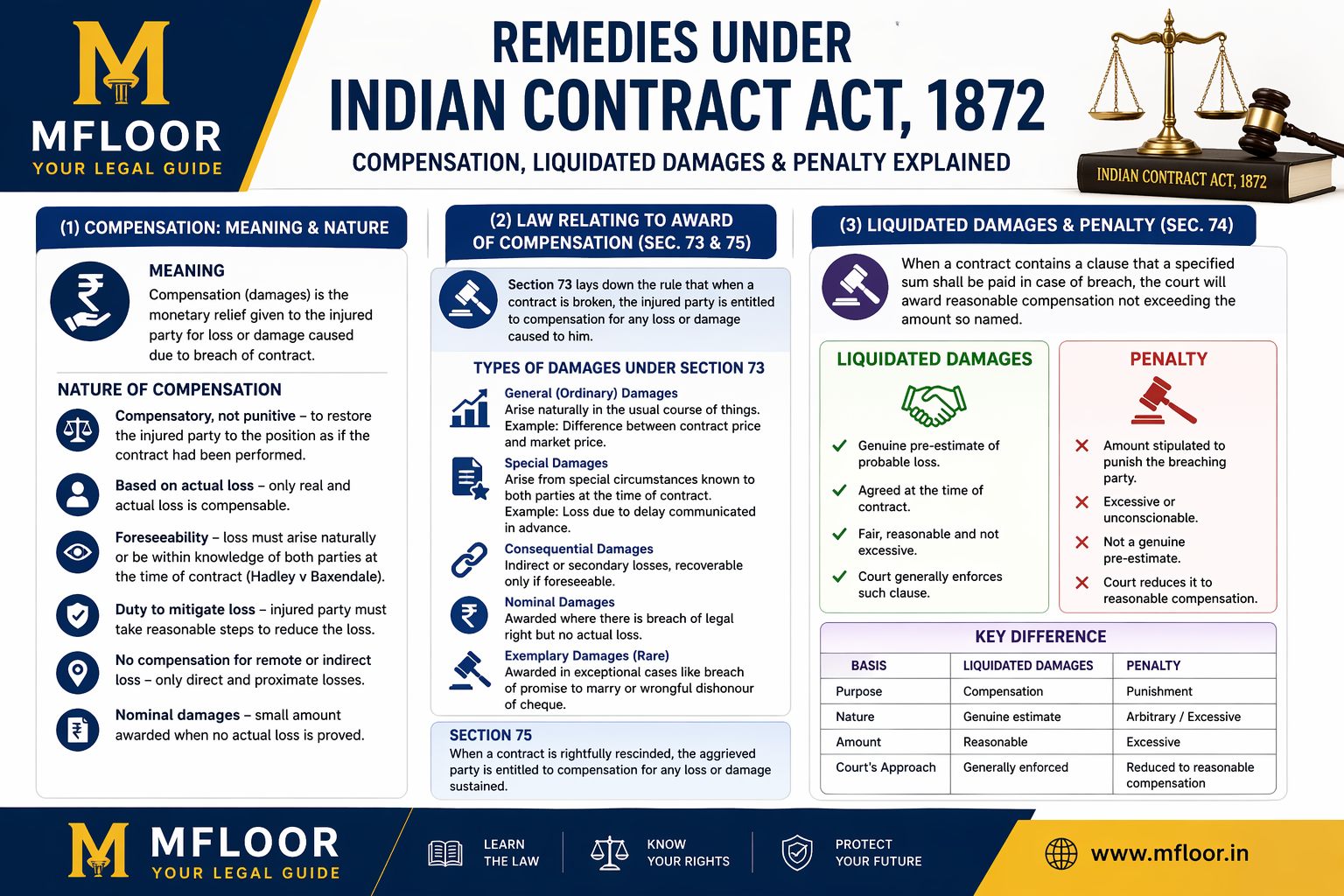
When a contract is breached, the law provides remedies to the aggrieved party. The primary remedy is compensation (damages), governed mainly by Sections 73, 74, and 75.
(1) 💰 COMPENSATION: MEANING AND NATURE
✅ Meaning of Compensation
Compensation refers to the monetary relief given to the injured party for the loss or damage caused due to breach of contract.
👉 The objective is not to punish the defaulter, but to repair the loss suffered.
🌿 Nature and Principles of Compensation
1. Compensatory in Nature (Not Penal)
- The law aims to place the aggrieved party in the same position as if the contract had been performed.
- It is based on the principle of restitution in integrum (restoration to original position).
2. Loss Must Be Actual and Real
- Compensation is awarded only for actual loss or damage.
- Hypothetical or speculative losses are not considered.
3. Foreseeability of Damage
- Only those damages are recoverable which:
- Arise naturally in the usual course of things, OR
- Were within the knowledge of both parties at the time of contract.
📌 This rule is derived from:
- Hadley v Baxendale
👉 Example:
If a mill owner informs the carrier that delay will cause loss of profit, then such loss is recoverable. Otherwise, it is not.
4. Duty to Mitigate Loss
- The injured party must take reasonable steps to reduce the damage.
- Cannot claim compensation for losses that could have been avoided.
👉 Example:
If goods are not delivered, the buyer should try to purchase substitute goods from the market.
5. No Compensation for Remote or Indirect Loss
- Damages must be proximate, not remote.
6. Certainty of Loss
- Loss must be quantifiable and provable.
- Courts do not award damages based on vague assumptions.
7. Nominal Damages
- If breach occurs but no real loss is suffered, courts may award nominal damages.
(2) ⚖️ LAW RELATING TO AWARD OF COMPENSATION (SECTION 73)
📘 Section 73 – Core Provision
This section lays down the rule that:
When a contract is broken, the injured party is entitled to compensation for loss or damage caused to him.
📌 Scope of Section 73
Compensation is given for:
✔️ (a) Loss arising naturally (Ordinary Damages)
- Direct and natural consequences of breach
👉 Example: Difference between contract price and market price
✔️ (b) Loss known to parties (Special Damages)
- Arising from special circumstances
- Must be communicated at the time of contract
👉 Example:
Supplier informed that delay will cause factory shutdown → Loss recoverable
❌ (c) Remote and Indirect Loss
- Not recoverable
👉 Example:
Loss of future speculative profits without prior knowledge
📊 Types of Damages under Section 73
1. General (Ordinary) Damages
- Direct losses from breach
- Automatically recoverable
2. Special Damages
- Arise from special conditions
- Must be communicated beforehand
3. Consequential Damages
- Secondary losses (allowed only if foreseeable)
4. Nominal Damages
- Small amount awarded where:
- Legal right is violated
- No actual loss proved
5. Exemplary or Vindictive Damages
- Awarded only in exceptional cases:
- Breach of promise to marry
- Wrongful dishonour of cheque by bank
⚠️ Important Rule: Mitigation of Loss
- Injured party must act reasonably
- Cannot recover damages for self-inflicted losses
📘 Section 75 – Compensation on Rescission
- When a contract is rightfully rescinded, the aggrieved party is entitled to compensation.
👉 Example:
If A cancels contract due to B’s breach, A can claim damages.
(3) 💣 LIQUIDATED DAMAGES AND PENALTY (SECTION 74)
📘 Section 74 – Key Principle
When a contract specifies a sum to be paid in case of breach:
👉 The court will award:
“Reasonable compensation not exceeding the amount so named.”
🔹 Liquidated Damages
✅ Meaning:
- A genuine pre-estimate of probable loss, agreed at the time of contract.
📌 Characteristics:
- Fair and reasonable
- Pre-calculated
- Not excessive
📌 Example:
A construction contract specifies ₹50,000 as damages for delay, based on estimated loss → Valid
🔸 Penalty
❌ Meaning:
- Amount stipulated to punish the breaching party, not to estimate loss
📌 Characteristics:
- Excessive or disproportionate
- Intended to deter breach
📌 Example:
₹10 lakh penalty for minor delay → Likely treated as penalty
⚖️ Distinction (Conceptual)
| Basis | Liquidated Damages | Penalty |
|---|---|---|
| Purpose | Compensation | Punishment |
| Nature | Genuine estimate | Arbitrary |
| Court Treatment | Allowed | Reduced |
🇮🇳 Indian Position vs English Law
- In English law → Strict distinction
- In Indian law (Section 74):
- No strict distinction
- Court focuses on reasonable compensation
👉 Even if amount is termed “penalty” or “liquidated damages”, court decides fairness.
⚖️ Landmark Case
- Fateh Chand v Balkishan Das
👉 Supreme Court held:- Compensation must be reasonable
- Not automatically equal to amount mentioned
🧠 FINAL ANALYSIS
The law of compensation under the Indian Contract Act, 1872 is based on:
✔️ Fairness and justice
✔️ Actual loss principle
✔️ Foreseeability rule
✔️ Prevention of unjust enrichment
👉 It ensures:
- Injured party is compensated
- Defaulting party is not excessively punished
✍️ CONCLUSION
Compensation is the cornerstone remedy for breach of contract. Sections 73, 74, and 75 create a balanced framework where:
- Genuine losses are compensated ✔️
- Remote claims are rejected ❌
- Excessive penalties are controlled ⚖️