
📝 Laws Relating to Certain Relations Resembling Those Created by Contract
💼 With Special Emphasis on Unjust Enrichment (Detailed Explanation)
⚖️ Meaning of Quasi Contract
🔍 Introduction
In legal systems, most obligations arise from contracts, where parties voluntarily agree to perform certain duties. However, there are situations where no agreement exists, yet one party is legally required to compensate another.
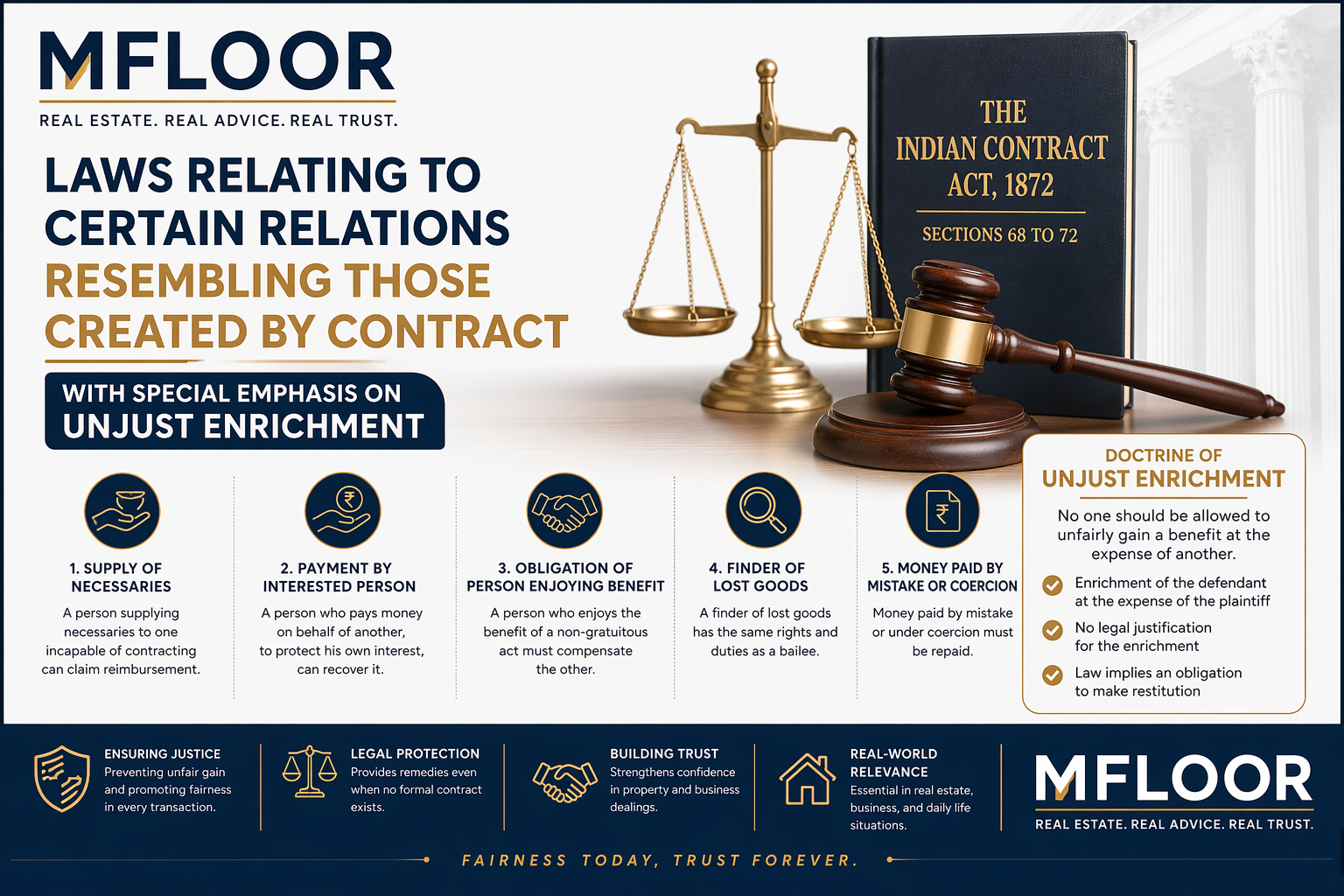
Such obligations are covered under “relations resembling those created by contract”, commonly known as quasi-contracts, under Sections 68 to 72 of the Indian Contract Act, 1872.
👉 The primary aim of these provisions is to ensure justice, equity, and fairness, mainly through the doctrine of unjust enrichment.
⚖️ Meaning of Quasi Contract
A quasi-contract is not an actual contract because:
- There is no offer and acceptance
- There is no mutual consent
- There is no intention to create legal relations
Yet, the law imposes an obligation as if a contract exists.
👉 Definition (Simple):
A quasi-contract is a legal obligation created by law to prevent one person from being unjustly enriched at the expense of another.
💡 Doctrine of Unjust Enrichment
📌 Meaning
Unjust enrichment refers to a situation where:
One person gains a benefit unfairly, and the law requires them to return or compensate for that benefit.
⚖️ Essential Elements
To establish unjust enrichment, the following must be present:
1️⃣ Enrichment – One person has received a benefit
2️⃣ At the expense of another – Another person has suffered loss
3️⃣ Unjust nature – The benefit is unfair or without legal justification
📊 Example
If ₹20,000 is mistakenly transferred to someone’s account, the receiver must return it.
👉 Even without a contract, the law enforces repayment.
⚖️ Provisions Under the Indian Contract Act, 1872
1️⃣ Section 68 – Supply of Necessaries
📌 Rule:
A person who supplies necessaries to someone incapable of contracting (like a minor) is entitled to reimbursement.
🧠 Key Points:
- Necessaries include food, clothing, shelter, education, medical aid
- Payment is made from the property of such person
📊 Example:
Providing medical treatment to an unconscious person → the provider can claim expenses.
2️⃣ Section 69 – Payment by Interested Person
📌 Rule:
If a person pays money which another is legally bound to pay, they can recover it.
🧠 Conditions:
- Payment must be made to protect one’s own interest
- The other party must be legally liable
📊 Example:
Paying someone else’s tax to prevent loss of property → recoverable.
3️⃣ Section 70 – Obligation of Person Enjoying Benefit
📌 Rule:
If a person:
- Lawfully does something for another
- Does not intend it to be free
- And the other person benefits
👉 The beneficiary must compensate.
🧠 Importance:
This section is the strongest expression of unjust enrichment.
📊 Example:
A builder mistakenly constructs a wall on your land, and you use it → you must pay.
4️⃣ Section 71 – Finder of Lost Goods
📌 Rule:
A finder of lost goods has rights and responsibilities similar to a bailee.
🧠 Duties:
- Take reasonable care
- Not misuse the goods
- Try to locate the owner
📊 Example:
Finding and safeguarding a lost phone → legal responsibility arises.
5️⃣ Section 72 – Money Paid by Mistake or Coercion
📌 Rule:
Money paid:
- By mistake, or
- Under coercion
👉 Must be repaid.
📊 Examples:
- Duplicate payment due to error
- Payment made under pressure
🏛️ Important Case Laws
📌 Moses v. Macferlan (1760)
Established the principle that law imposes obligations to prevent unjust enrichment.
📌 State of West Bengal v. B.K. Mondal & Sons
Held that compensation must be paid when a person enjoys the benefit of another’s lawful act, even without a contract.
⚖️ Difference Between Contract and Quasi-Contract
| Basis | Contract | Quasi-Contract |
|---|---|---|
| Formation | By agreement | Imposed by law |
| Consent | Required | Not required |
| Nature | Voluntary | Involuntary |
| Purpose | To enforce promises | To prevent unjust enrichment |
🧾 Practical Importance
🏡 In Real Estate
- Unauthorized improvements benefiting owners
- Services provided without formal agreement
- Mistaken property payments
💼 In Daily Life & Business
- Online payment errors
- Delivery of goods by mistake
- Emergency services without prior agreement
⚖️ Remedies
💰 Restitution
The primary remedy is restitution, meaning:
- Return of benefit
- Payment for services
- Compensation for unjust gain
👉 Objective: Restore the original position of parties.
🧠 Critical Analysis
✅ Advantages:
- Ensures fairness without formal contracts
- Prevents exploitation
- Promotes justice and equity
❗ Limitations:
- Determining “unjust” can be subjective
- Valuation of benefit may lead to disputes
🏁 Conclusion
The law relating to relations resembling contracts ensures that justice is not limited to formal agreements. Through the doctrine of unjust enrichment, it guarantees that:
✔ No one benefits unfairly
✔ Losses are compensated
✔ Equity is maintained in society
👉 These principles are essential in modern legal and commercial systems, where not all dealings are governed by formal contracts.