
📜 DISCHARGE OF CONTRACT: MEANING & MODES
🔍 Meaning / Definition of Discharge of Contract
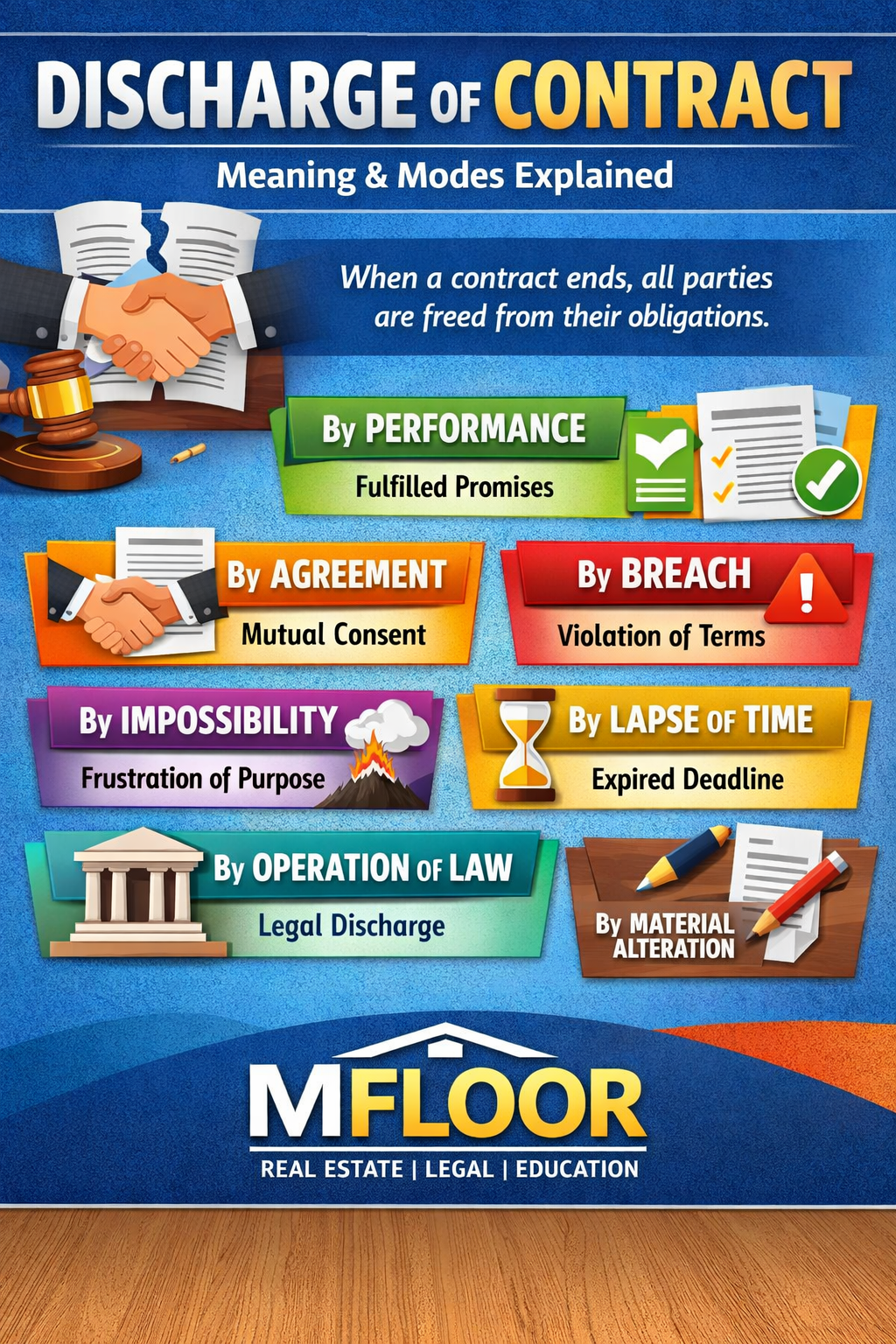
Discharge of a contract means the termination or ending of a contractual relationship between the parties.
👉 Definition (Simple Form):
When the rights and obligations arising out of a contract come to an end, the contract is said to be discharged.
👉 Legal Understanding:
A contract is discharged when the parties are freed from their respective duties and liabilities under the agreement.
⚖️ MODES OF DISCHARGE OF CONTRACT (WITH DEFINITIONS)
✅ 1. Discharge by Performance
📖 Definition:
Discharge by performance occurs when all parties fulfill their respective promises according to the terms of the contract.
🔹 Types:
✔️ (a) Actual Performance
When each party performs their obligations fully and correctly.
🤝 (b) Attempted Performance (Tender)
When a party offers to perform, but the other party refuses to accept it.
📌 Key Points:
- Performance must be complete and exact
- Must be done at the proper time and place
- After performance → contract ends automatically
🤝 2. Discharge by Mutual Agreement
📖 Definition:
A contract may be discharged when all parties mutually agree to terminate or modify it.
🔹 Forms:
🔄 (a) Novation
Replacement of an existing contract with a new one, either by changing parties or terms.
✏️ (b) Alteration
Change in one or more terms of the contract with mutual consent.
❌ (c) Rescission
Cancellation of the contract by mutual agreement, releasing all parties.
💵 (d) Remission
Acceptance of lesser performance than originally agreed.
🚫 (e) Waiver
Voluntary abandonment of a legal right by a party.
❌ 3. Discharge by Breach of Contract
📖 Definition:
A contract is discharged by breach when one party fails or refuses to perform their obligations.
🔹 Types:
⚠️ (a) Actual Breach
Failure to perform on the due date or during performance.
⏳ (b) Anticipatory Breach
When a party declares in advance that they will not perform their obligation.
📌 Rights of Aggrieved Party:
- May terminate the contract immediately
- Or wait until the due date
🌪️ 4. Discharge by Impossibility of Performance
📖 Definition:
A contract is discharged when performance becomes impossible or unlawful, due to circumstances beyond control.
🔹 Types:
❌ (a) Initial Impossibility
The act is impossible from the beginning → contract is void ab initio.
🌧️ (b) Supervening Impossibility
Performance becomes impossible after formation of the contract.
📌 Causes:
- Death or incapacity
- Natural disasters
- War
- Change in law
- Destruction of subject matter
⚖️ Doctrine of Frustration
When an unforeseen event makes performance impossible or radically different, the contract becomes void.
⏳ 5. Discharge by Lapse of Time
📖 Definition:
A contract is discharged if it is not performed within the prescribed time limit.
📌 Explanation:
- Governed by limitation law
- After expiry, contract becomes unenforceable
⚖️ 6. Discharge by Operation of Law
📖 Definition:
A contract is discharged automatically by the operation of law, without any action by the parties.
🔹 Situations:
- Death (in personal contracts)
- Insolvency
- Merger of rights
- Unauthorized material alteration
✏️ 7. Discharge by Material Alteration
📖 Definition:
When one party makes a material change in the contract without consent of the other party, the contract is discharged.
📌 Key Point:
- Change must affect the rights or obligations
- Contract becomes void
🧠 Quick Summary Table
| Mode | Meaning |
|---|---|
| ✅ Performance | Completion of obligations |
| 🤝 Agreement | Mutual decision to end/modify |
| ❌ Breach | Failure to perform |
| 🌪️ Impossibility | Performance becomes impossible |
| ⏳ Time Lapse | Legal time expires |
| ⚖️ Law | Discharge by legal rules |
| ✏️ Alteration | Unauthorized change |
🏁 Conclusion
Discharge of contract is an essential concept that defines how and when contractual obligations end. It ensures fairness and legal clarity by providing multiple ways to terminate a contract depending on the situation.