
📘 VOID AGREEMENT Under Indian Contract Act 1872
Meaning & Agreements Declared Void under the Indian Contract Act, 1872
(With Special Emphasis on Restraint of Trade & Wagering Agreements)
🔹 Meaning of Agreement
According to Section 2(e) of the Indian Contract Act, 1872:
👉 “Every promise and every set of promises, forming the consideration for each other, is an agreement.”
✔ In simple terms, an agreement is formed when one party makes a promise and the other party accepts it with consideration.
🔹 What is a Void Agreement?
As per Section 2(g):
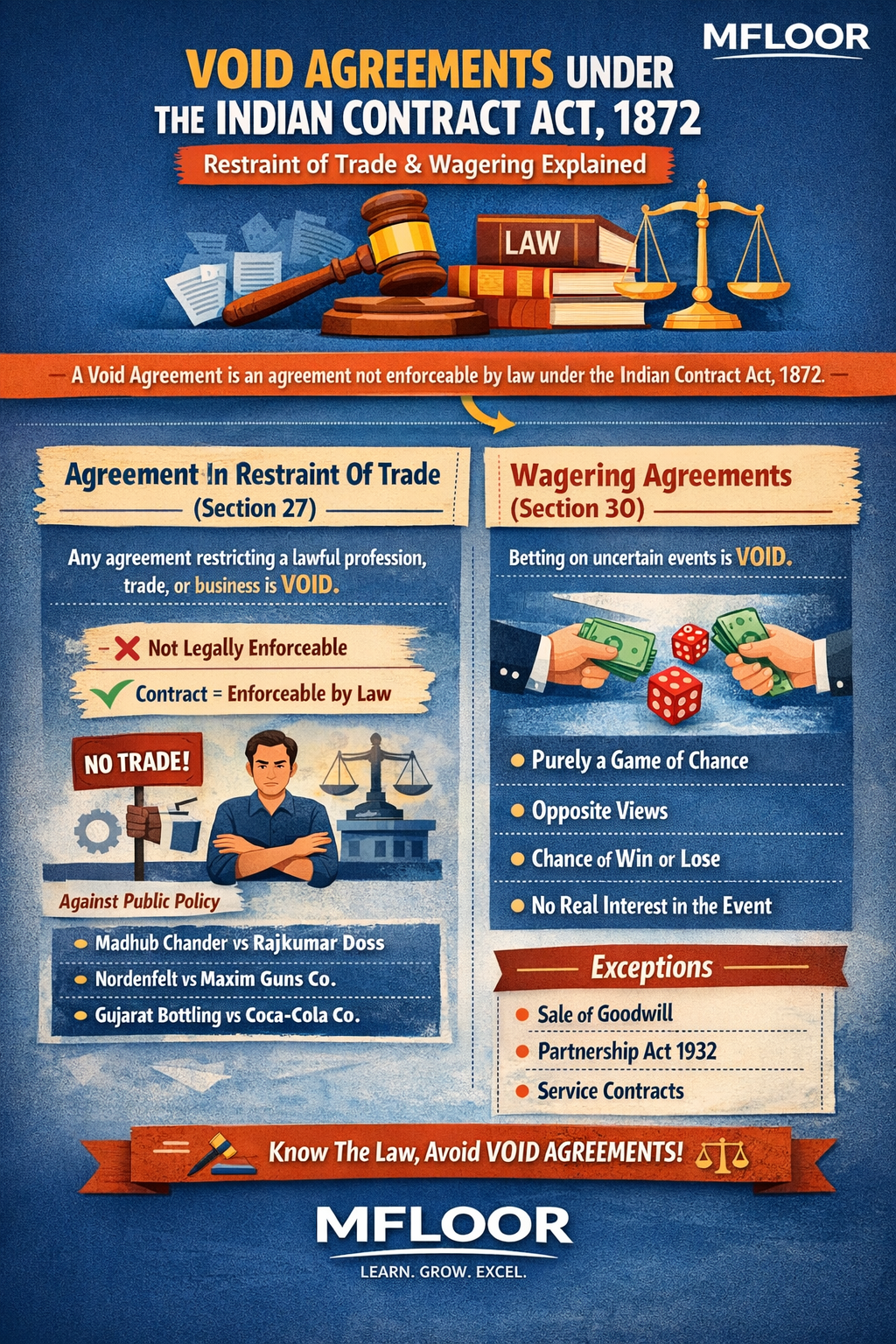
👉 “An agreement not enforceable by law is said to be void.”
✔ Example:
An agreement made with a minor is void from the beginning.
📌 Sections 24 and 30 of the Act specifically mention certain agreements that are void.
👉 Therefore:
- A void agreement has no legal effect.
- A contract is legally enforceable.
🔗 Related Topic: Understanding the basics of a valid contract helps in identifying void agreements.
🔹 What is a Contract?
According to Section 2(h):
👉 “An agreement enforceable by law is a contract.”
⚠️ Important Note:
All agreements are not contracts because not all agreements are enforceable by law.
📜 Agreements Declared Void under the Indian Contract Act, 1872
Even if an agreement satisfies all the essential elements of a valid contract, it may still be declared void by law in the following cases:
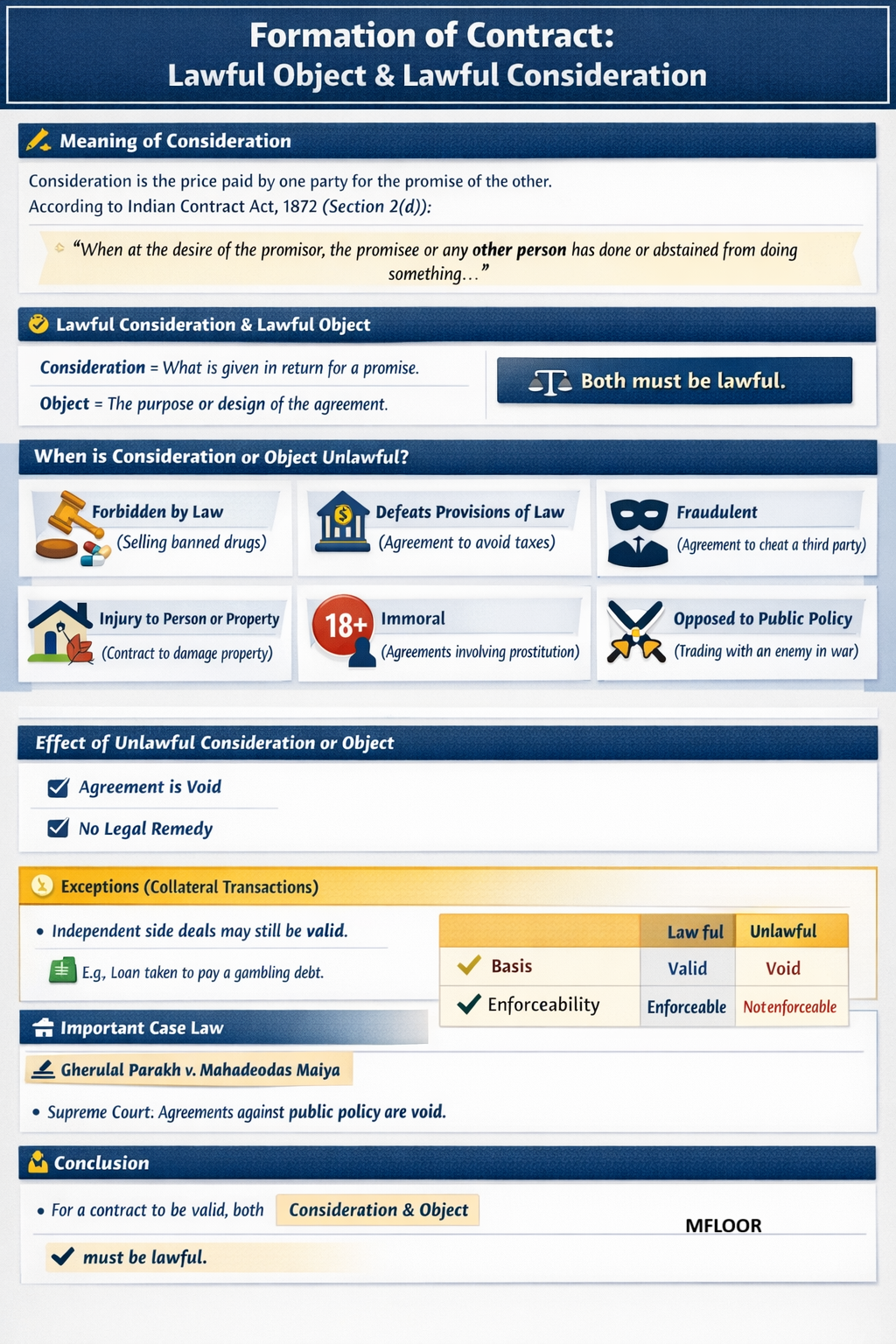
- Agreements with unlawful consideration or object (Sections 23 & 24)
- Agreements without consideration (Section 25)
- Agreements in restraint of marriage (Section 26)
- Agreements in restraint of trade (Section 27)
- Agreements in restraint of legal proceedings (Section 28)
- Agreements that are uncertain or ambiguous (Section 29)
- Wagering agreements (Section 30)
- Agreements to do impossible acts (Section 56)
🔗 You may also read about “Essentials of a Valid Contract” to understand why these agreements fail.
⭐ Special Focus Areas
🔸 1) Agreement in Restraint of Trade
📖 As per Section 27:
👉 Every agreement by which a person is restrained from exercising a lawful profession, trade, or business of any kind is, to that extent, void.
✔ This means any agreement that restricts a person’s freedom to carry on a lawful business is generally invalid.
⚖️ Legal Principle:
Such agreements are considered against public policy.
❗ Important Point:
Indian law does not differentiate between total and partial restraint—both are void.
📌 Important Case Laws
- Madhub Chander v. Rajcoomar Doss
- Nordenfelt v. Maxim Nordenfelt Guns and Ammunition Co. Ltd.
- Gujarat Bottling Co. Ltd. v. Coca Cola Co.
🔗 These landmark judgments explain how courts interpret restraint of trade in different situations.
✅ Exceptions to Restraint of Trade
- Sale of Goodwill – A seller may agree not to start a similar business within a specified area.
- Partnership Exceptions under the Indian Partnership Act, 1932
- Contracts of Service – Reasonable restrictions during employment are valid
- Trade Combinations – Agreements regulating business practices
- Solus Agreements – Exclusive dealing agreements
🔗 Learn more about partnership agreements to understand these exceptions better.
🔸 2) Wagering Agreements
📖 Section 30 states:
👉 “Agreements by way of wager are void, and no suit shall be brought for recovering anything alleged to be won on any wager.”
✔ Such agreements are not enforceable in a court of law.
❓ What is a Wagering Agreement?
Although the Act does not define it, the concept was explained in:
- Carlill v. Carbolic Smoke Ball Co.
👉 Simplified Meaning:
A wagering agreement is a contract where two parties agree that one will win and the other will lose money based on the outcome of an uncertain future event.
📌 Essentials of a Wagering Agreement
- 🎯 Both parties have opposite views regarding an uncertain event
- 💰 There is a chance of gain or loss for both parties
- ❌ There is no other interest except winning or losing the bet
🔗 Related Concept: Contingent contracts are different from wagering agreements and are legally valid under certain conditions.
📝 Conclusion
- A void agreement is not enforceable by law and has no legal effect.
- Agreements in restraint of trade and wagering agreements are declared void to protect public interest and fairness.
- Understanding these provisions helps in distinguishing between valid contracts and void agreements under the Indian Contract Act, 1872.