
Here’s a clear and structured explanation of Formation of Contract – Essential Conditions: Proposal and Acceptance, including the law relating to communication, acceptance, and revocation under contract law (primarily based on principles from the Indian Contract Act, 1872).
📘 Formation of Contract
Essential Conditions: Proposal and Acceptance
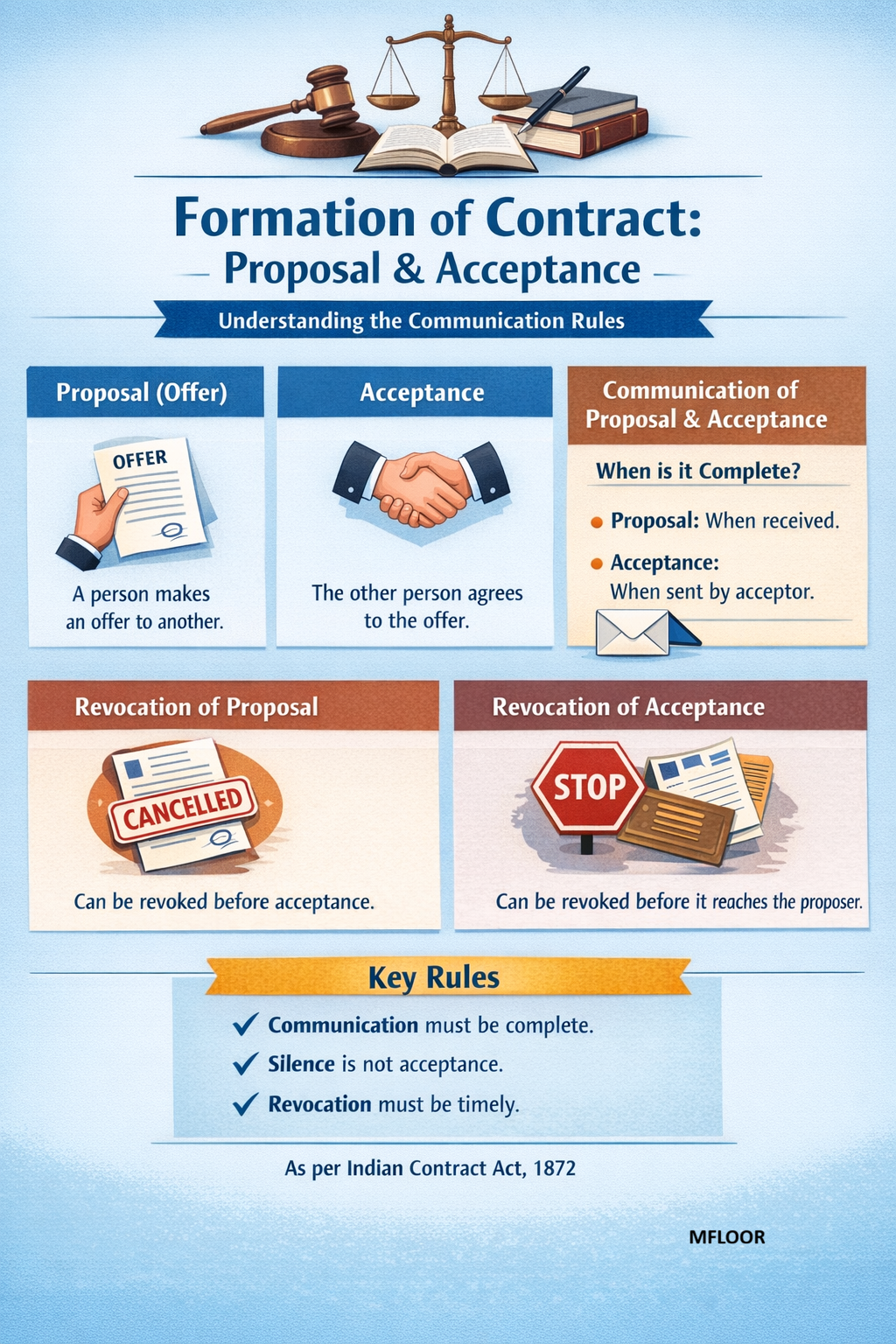
A contract is formed when one party makes an offer (proposal) and the other party accepts it. These are the foundation of a valid contract.
🔹 1. Proposal (Offer)
✅ Meaning
According to Section 2(a) of the Indian Contract Act:
A proposal is when one person signifies to another their willingness to do or abstain from doing something, with a view to obtaining the assent of that other person.
👉 The person making the proposal = Promisor
👉 The person accepting = Promisee
📌 Example
A says to B, “I will sell my bike for ₹50,000.”
➡️ This is a proposal.
🔹 2. Acceptance
✅ Meaning
As per Section 2(b):
When the person to whom the proposal is made assents to it, the proposal becomes a promise.
👉 Acceptance must be:
- Absolute and unqualified
- Communicated properly
- Given in the prescribed or reasonable manner
📌 Example
B says, “I accept your offer.”
➡️ This becomes a contract (promise).
🔹 3. Communication of Proposal
📖 Legal Rule
The communication of a proposal is complete when it comes to the knowledge of the person to whom it is made.
📌 Example
A sends a letter to B offering to sell goods.
➡️ Proposal is complete when B receives and reads it.
🔹 4. Communication of Acceptance
Communication of acceptance has two aspects:
(A) As against the proposer
It is complete when the acceptance is put into a course of transmission to him.
(B) As against the acceptor
It is complete when it comes to the knowledge of the proposer.
📌 Example (Postal Rule)
A offers by letter. B posts acceptance.
- Against A (proposer): Complete when B posts the letter
- Against B (acceptor): Complete when A receives it
🔹 5. Communication of Revocation
Revocation means cancellation of proposal or acceptance.
📖 Legal Rule
Communication of revocation is complete:
- Against the person who revokes → when it is put into transmission
- Against the person to whom it is made → when it comes to their knowledge
🔹 6. Revocation of Proposal
A proposal can be revoked:
- Before acceptance is complete against the proposer
- But not after acceptance is posted
📌 Example
A sends offer to B.
B posts acceptance.
➡️ A cannot revoke after B has posted acceptance.
🔹 7. Revocation of Acceptance
Acceptance can be revoked:
- Before it reaches the proposer
📌 Example
B sends acceptance by letter.
Then sends a faster telegram rejecting it.
➡️ If rejection reaches A first, acceptance is revoked.
🔹 8. Key Rules Summary
| Concept | When Communication is Complete |
|---|---|
| Proposal | When it comes to knowledge of receiver |
| Acceptance (Proposer) | When posted/sent |
| Acceptance (Acceptor) | When received |
| Revocation | When received by the other party |
⚖️ Important Points to Remember
- Silence is not acceptance
- Acceptance must match the proposal exactly
- Communication is essential for validity
- Revocation must be timely
🧾 Conclusion
Proposal and acceptance are the core elements in the formation of a contract. The law ensures clarity by defining when communication is complete and when revocation is valid. Understanding these rules helps avoid disputes and ensures legally enforceable agreements.
If you want, I can also:
✅ Convert this into exam notes (short answers)
✅ Create case laws/examples for better understanding
✅ Provide MCQs for practice
COMMENT BELOW