
The Union Executive of India is a crucial part of the political system established under the Constitution of India. Constitution consists of the President(Indian President Powers), Vice-President, Prime Minister, Council of Ministers, and the Attorney General. Among these, the President of India is the nominal executive head of the Union.
The President of India: Powers and Position(Indian President Powers).
1. Position of the President
The President of India holds a unique constitutional position:
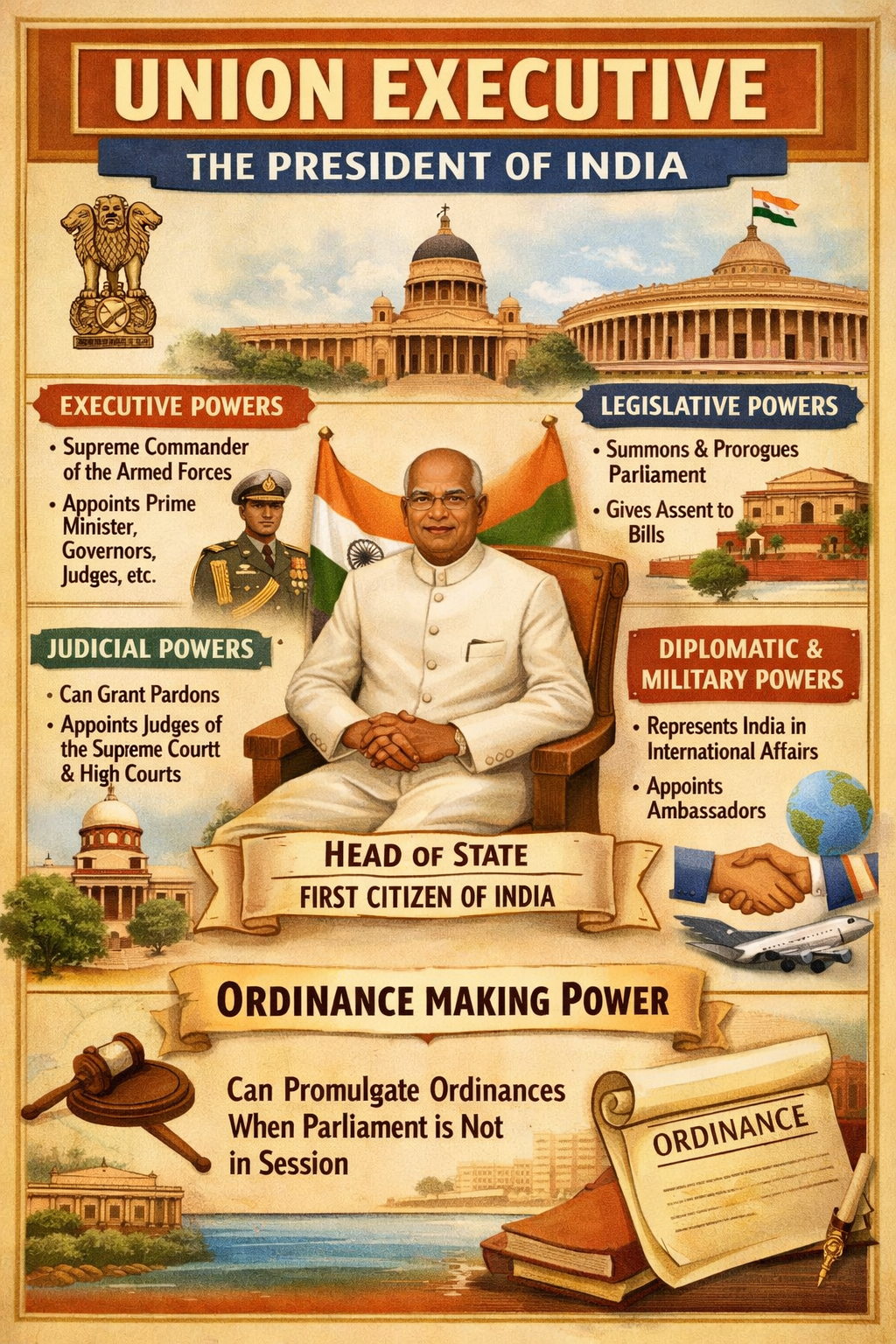
- He is the constitutional head of the State and the first citizen of India.
- All executive actions of the Union are taken in his name.
- However, real executive power lies with the Council of Ministers headed by the Prime Minister due to the principle of parliamentary government.
- The President acts on the aid and advice of the Council of Ministers (Article 74).
👉 Thus, the President is often described as a “nominal executive”, while the Prime Minister is the real executive.
2. Powers of the President
A. Executive Powers
- Appoints the Prime Minister and other ministers.
- Appoints key officials such as:
- Governors of states
- Judges of the Supreme Court and High Courts
- Comptroller and Auditor General (CAG)
- Administers Union Territories through administrators.
B. Legislative Powers
- Summons, prorogues Parliament, and dissolves the Lok Sabha.
- Addresses Parliament at the beginning of sessions.
- Can nominate members to:
- Rajya Sabha (12 members with special knowledge)
- Gives assent to bills—without his approval, a bill cannot become law.
- Can return non-money bills for reconsideration.
C. Financial Powers
- No money bill can be introduced without his recommendation.
- Causes the Union Budget to be laid before Parliament.
- Appoints the Finance Commission.
D. Judicial Powers
- Grants pardons, reprieves, respites, or remissions of punishment.
- Can suspend or commute sentences, including death sentences.
E. Emergency Powers
The President can declare:
- National Emergency (Article 352)
- State Emergency / President’s Rule (Article 356)
- Financial Emergency (Article 360)
3. Ordinance-Making Power of the President
The ordinance-making power is one of the most significant legislative powers of the President.
Constitutional Provision
- Provided under Article 123 of the Constitution of India.
When Can an Ordinance Be Issued?
The President can promulgate an ordinance when:
- Parliament is not in session, and
- Immediate action is necessary.
Nature and Effect
- An ordinance has the same force and effect as an Act of Parliament.
- It is a temporary law.
Duration
- Must be approved by Parliament within 6 weeks of reassembly.
- If not approved, it ceases to operate.
Limitations
- Can only be issued on matters where Parliament has the power to legislate.
- Subject to judicial review.
- Cannot violate fundamental rights or basic structure.
Important Case
- In D.C. Wadhwa v. State of Bihar, the Supreme Court held that repeated re-promulgation of ordinances is unconstitutional.
4. Real Position of the President
Although the Constitution vests wide powers in the President:
- He generally acts on the advice of the Council of Ministers.
- However, he may exercise discretion in certain situations, such as:
- Appointment of Prime Minister in a hung Parliament
- Returning a bill for reconsideration
- Seeking information from the Prime Minister
👉 Therefore, the President is not merely a figurehead, but also a constitutional guardian and stabilizing authority.
Conclusion
The President of India occupies a position of dignity, authority, and constitutional significance. While most powers are exercised on ministerial advice, provisions like the ordinance-making power enable the executive to respond swiftly in urgent situations, ensuring continuity in governance.